

Devil's Lake State Park: Hiking, climbing and admission guide
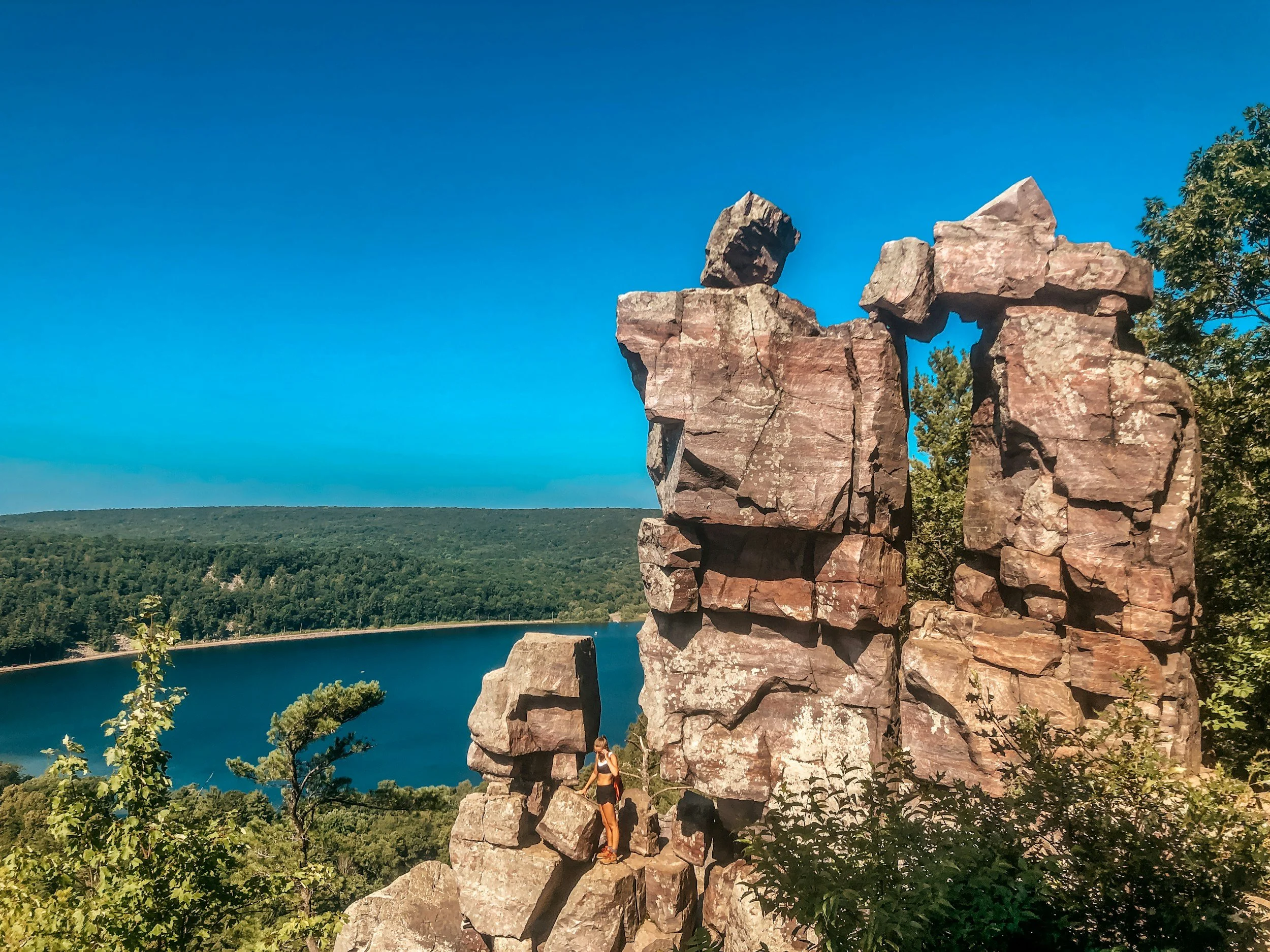
Devil's Lake State Park is a fantastic day trip, which can be stretched into a weekend without running out of things to do.
The 9,217-acre park wraps a 360-acre glacier-dammed lake inside 500-foot quartzite bluffs that are roughly 1.6 billion years old—among the oldest exposed rock on Earth—and it draws close to three million visitors a year, making it Wisconsin's most-visited state park.
The appeal is simple: world-class hiking, two sandy swim beaches, affordable camping, and Wisconsin Dells on the doorstep. The trade-off is real crowding on summer weekends, so this guide is built around what's changed for 2025–2026, how to dodge the crowds, and which activities match which ages.
Admission, reservations, and camping
Wisconsin overhauled its vehicle-sticker system. Here are the essentials every visiting family needs to know before they leave the driveway.
Annual passes are now valid 12 months from the month of purchase, not calendar-year: $28 Wisconsin resident, $38 non-resident; second household vehicle $15.50 resident, $20.50 non-resident; senior resident (65+) $13.
Daily vehicle admission is $13 for Wisconsin plates, $16 for out-of-state, and Devil's Lake is one of the only parks that sells an hourly pass. Holders of the federal America the Beautiful pass enter free because the park is part of the Ice Age National Scientific Reserve.
Every campsite now requires a reservation—the old first-come sites in Quartzite are gone—booked up to 11 months ahead through wisconsin.goingtocamp.com, and the 2-vehicle-per-site cap is being enforced.
Note: There are also options to get free state park admission, including on family fun weekend, for veterans and through library park passes.
There is no day-use reservation at Devil's Lake, but parking lots fill by mid-morning on summer and fall weekends and entry is paused when they do. Buy your sticker online at shop.wi.gov/dnrparkspasses or YourPassNow.com—the emailed receipt works immediately—so you can roll past the kiosk line. The 2026 Free Fun Weekend is June 6–7, when admission is waived statewide; arrive at dawn or skip it.
Hiking trails ranked by age and ambition
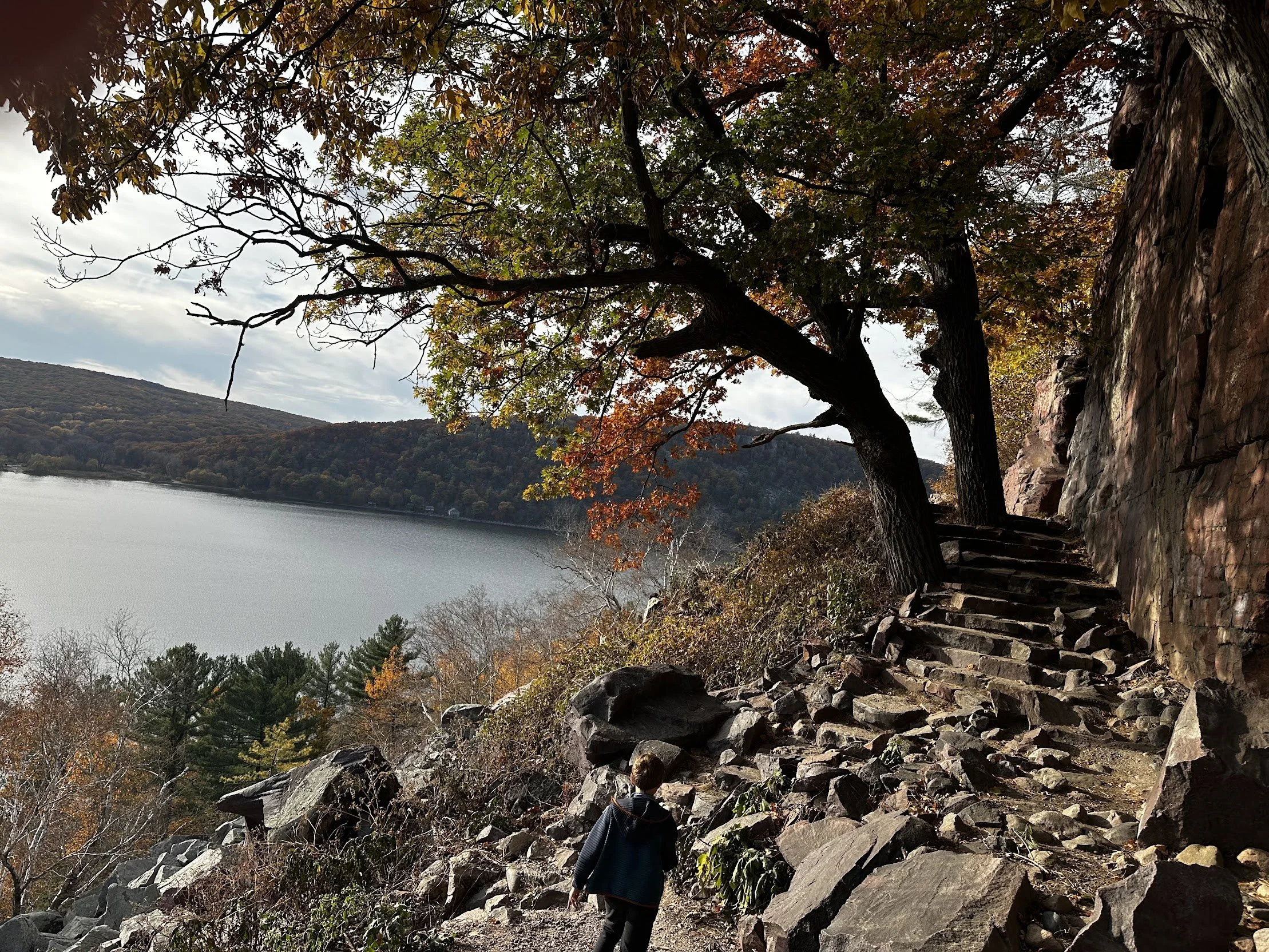
Devil's Lake has about 29 miles of trails on 16 marked routes, and the honest truth is that the famous bluff hikes are hard and exposed, while the quieter trails around them are the real family gems. Cliff edges are unfenced, stone staircases are slick when wet, and the park averages roughly one fatal fall per year, so footwear and supervision are non-negotiable—no flip-flops, no phones-out-on-the-edge selfies.
For toddlers and preschoolers, the Grottos Trail is the winner: fine gravel, mostly level, shaded natural alcoves that stay cool on 90-degree days, and it connects to the base of the East Bluff so older siblings can peel off for a harder climb. The Tumbled Rocks Trail runs about a mile along the lake's western shore through a jumble of pink quartzite boulders—the northern half is paved well enough for a sturdy-wheeled stroller, the southern half gets rough. The south shore boardwalk and the paved paths in both day-use areas round out the stroller-friendly options; the park publishes roughly 1.5 miles of accessible trail, and the Chateau loans out a beach wheelchair and mat for the North Beach.
For elementary kids, the best introduction to the bluffs is a partial East Bluff hike starting from North Shore up to Elephant Rock and Elephant Cave and back—about an hour with gradual climbing and real payoff. The flat 2.4-mile Steinke Basin Loop through glacial kettles is great for early-reader naturalists, and Parfrey's Glen, managed as part of Devil's Lake about 15 minutes east, is a magical moss-and-fern gorge that kids remember forever (more on its quirks below).
For tweens, teens, and fit parents, the signature outing is the 4.3-mile lake loop combining East Bluff and Tumbled Rocks, about 544 feet of climb and 1.5–2 hours, which passes Devil's Doorway, the most-photographed rock formation in Wisconsin. The West Bluff Trail (1.5 miles one way, 400-plus feet of climb) tops out at Prospect Point, the park's highest overlook. The Balanced Rock Trail is only 0.4 miles but a brutal stone staircase that the DNR essentially classifies as mountaineering—save it for experienced teens and bring trekking poles.
Park-wide hiking tips: bring far more water than you think you need (there is none on trails), download the DNR map PDF before you arrive because cell service is spotty, watch for poison ivy and wild parsnip at trail edges, and know that timber rattlesnakes do live in the park but are shy and rarely seen.
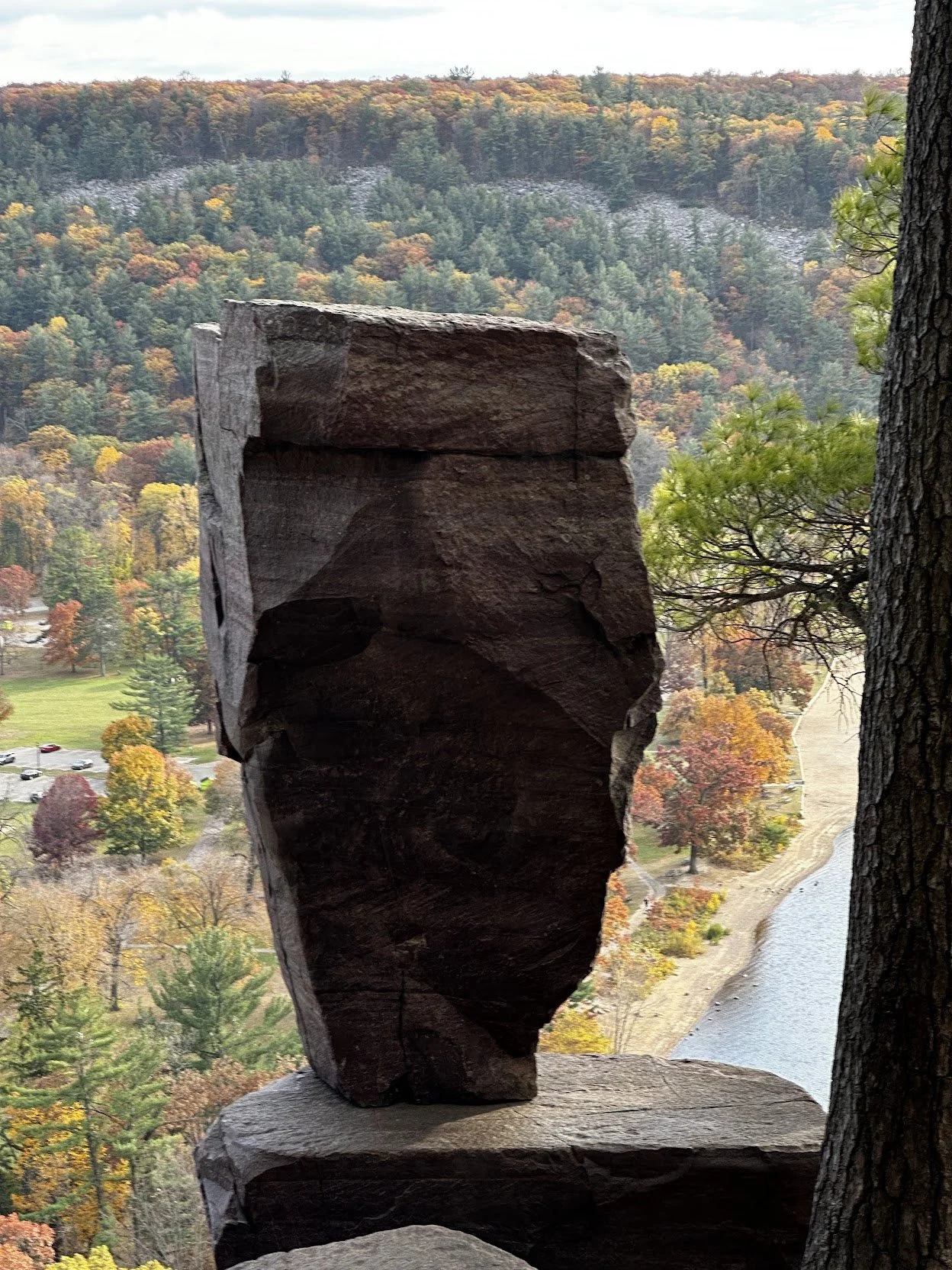
Balanced Rock Trail
Two beaches
The North Shore beach has finer sand and easy walking access to the historic CCC-era Chateau, which sells snacks, ice cream, beer, and a cash-only Friday fish fry ($16 for two pieces, $19 for three in 2025). The South Shore beach is wider, stays sunny into the evening, has more parking, and anchors a cluster of seven reservable picnic shelters. Both have bathhouses with showers and changing rooms, playgrounds nearby, and gradual sandy entries that work well for young kids.
There are no lifeguards on either beach—swim at your own risk inside the buoyed areas—and swimmer's itch is reported most years, especially early summer, so towel off vigorously and rinse when you come out. The Sauk County health department occasionally posts E. coli advisories; check the DNR page before you leave. Water is typically comfortable mid-June through late September and reaches 45–47 feet deep in the middle, which is why the lake is also popular with scuba divers. Pets are not allowed on the swim beaches, but there's an on-leash dog swim area near the north boat launch and an off-leash one near the south.
Climbing Wisconsin's best quartzite
Devil's Lake is the premier rock-climbing destination in the Midwest, with over 1,600 established routes in the standard Swartling & Mayer guidebook. The rock is Baraboo quartzite—1.6 billion years old, sharp, slick, and notoriously sandbagged, meaning grades feel harder than the number suggests. No permits or registration are required, despite what a few third-party sites claim; you just need a park sticker. The park's own phrasing is that it "neither prohibits nor promotes rock climbing."
Critically, Devil's Lake is trad and bouldering only—there are no bolts anywhere in the park, and the local ethic forbids placing any. Climbers need to lead on removable gear or build top-rope anchors from natural features by hiking to the top. East Rampart off the CCC Trail is the most popular area; Balanced Rock, Cleopatra's Amphitheater, and the West Bluff crags also see heavy traffic. Families new to climbing should book Devils Lake Climbing Guides (devilslakeclimbingguides.com), in business since 2012, which runs beginner clinics, kid-appropriate days, and anchor-building courses with wilderness-medicine-certified instructors.
Paddling the lake and fishing basics
Devil's Lake is electric-motor only—no gas engines—which keeps the water calm and safe for paddlers. The nonprofit Devil's Lake Concessions rents kayaks, canoes, paddleboats, stand-up paddleboards, and an adaptive kayak (call ahead) out of boathouses at both the North Chateau and the South Shore building; singles run about $15 an hour and doubles about $24 based on recent season pricing, first-come-first-served, weather-dependent. Call (608) 356-3381 to confirm current rates. Personal boats launch free from ramps at the north and south ends of the lake, and paddling the full shoreline takes about two hours. Life jackets are required for every occupant, including in rubber rafts.
Fishing-wise, the lake is stocked with brown and rainbow trout, walleye, and northern pike and also holds largemouth and smallmouth bass, bluegill, crappie, and perch. Anyone 16 or older needs a Wisconsin license (buy through the GoWild system), and trout fishing needs the additional trout stamp. The park office runs a free loaner-tackle program—call ahead to reserve rods for the kids. Best shore fishing is along the south-shore sidewalk and from both boat ramps.
More activities to include
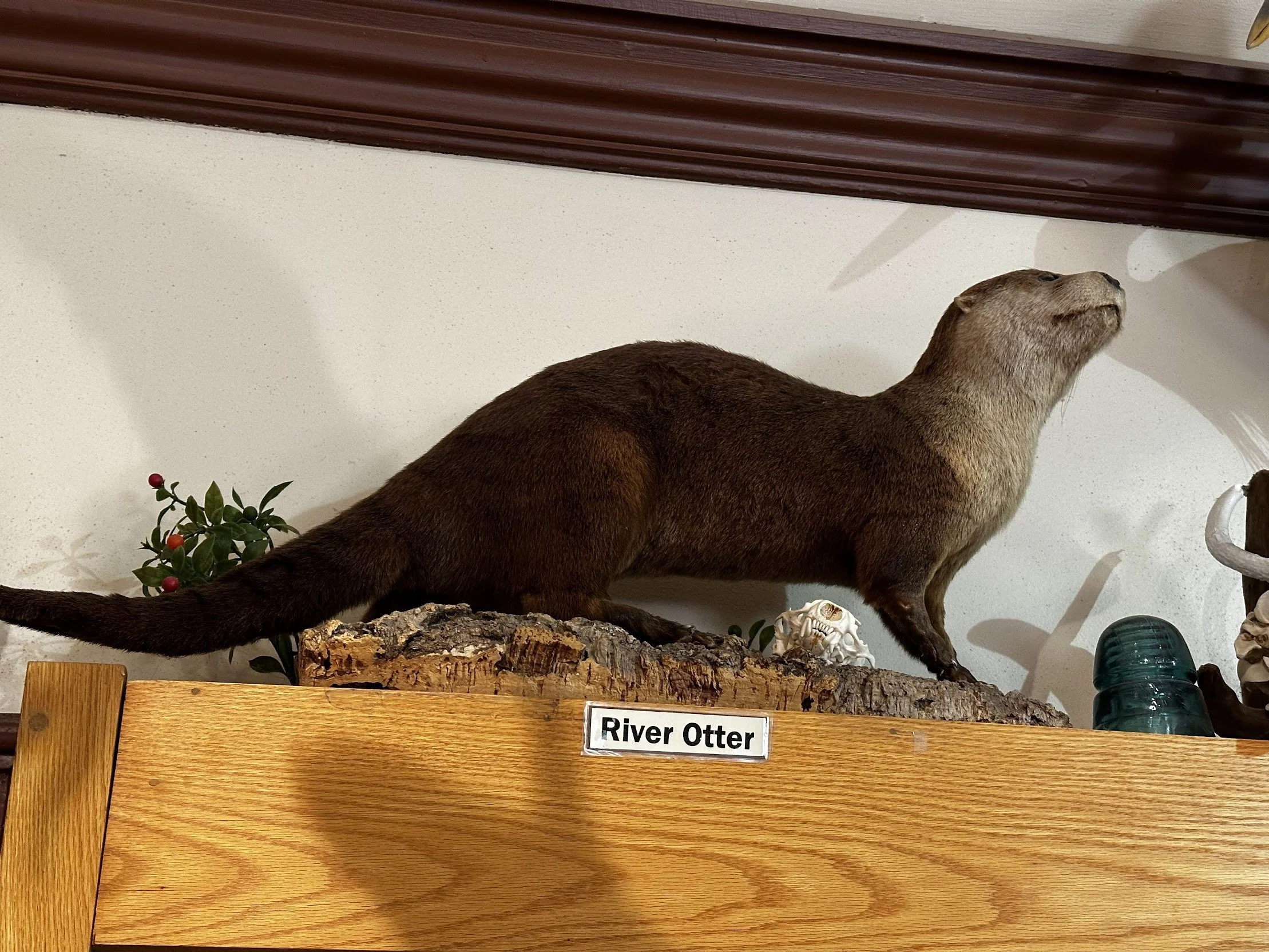
The Devil’s Lake nature Center
Beyond the headline hikes and swimming, Devil's Lake quietly delivers strong birdwatching (about 115 species; loons return every spring, and Parfrey's Glen, Roznos Meadow, and Steinke Basin are the quiet-dawn hotspots). Mountain biking is essentially one trail: the ~4-mile Upland Loop, natural surface, beginner-to-intermediate, with bikers yielding to hikers—bikes are banned on every other trail. The Nature Center on the North Shore is open daily 10–4 from Memorial Day through Labor Day, with a 3-D park model, a kids' discovery room, summer naturalist programs Tuesday–Saturday, and Saturday-night amphitheater programs at Northern Lights Campground.
Winter turns the park into a quieter playground: no groomed trails (neighboring Mirror Lake has 18 miles of groomed XC if that matters), but snowshoeing is allowed anywhere and the Nature Center loans snowshoes free on select Saturdays. Ice fishing is popular once the lake freezes, though the park doesn't monitor ice thickness—use judgment. There's a sledding hill at Northern Lights and winter camping continues at Quartzite.
Camping and how to actually get a site
The park has 423 family campsites across three campgrounds, plus nine group sites near South Shore. Every site is now reservable, and the summer-weekend and mid-September-through-mid-October fall-color windows book out close to the 11-month mark. Here's how the three stack up.
Quartzite Campground (sites 1–100) sits on the grounds of a former nine-hole golf course, so it's the sunniest and most open—ideal for spring and fall, hot in July. It's open year-round, has showers, flush toilets, and a dump station (seasonal), and walks you to the North Shore amenities in about five minutes. Northern Lights (sites 104–246) is the prize for most families: 71 electric sites, the only campground with wooded electric options, four heated shower buildings (three built by the CCC in the 1930s), and a playground. Open mid-April to mid-October. Ice Age Campground is the tent-camper's choice—all non-electric, fully wooded in the upper section, about a mile from the lake.
Peak-season site rates at Devil's Lake are above the Wisconsin baseline because it's a top-tier park on differential pricing: expect roughly $30 to as much as $53 per night depending on residency, day of week, and site type, plus a non-refundable $7.50–$7.75 reservation fee. Cancel by 3 p.m. Central two days before arrival for a refund minus fees. If Devil's Lake is full, Mirror Lake State Park ten minutes north has 151 family sites and often has openings when Devil's Lake doesn't; Rocky Arbor, White Mound County Park, and private campgrounds like Yogi Bear's Jellystone and the Wisconsin Dells KOA round out the overflow options.
Where to sleep if you're not camping
Baraboo proper has a solid bench of family-friendly hotels five to ten minutes from the park's North Shore. The Fairfield Inn & Suites by Marriott on Gateway Drive is the cleanest pick for a free-breakfast-plus-indoor-pool stay. The AmericInn & Suites Baraboo has a fourth-floor pool with bluff views and is pet-friendly. The Clarion Hotel & Convention Center offers indoor pool, jacuzzi, and Glacier Rock Restaurant on site, and the Cobblestone Inn is a reliable budget pick. Summer weekend rates land mostly in the $140–$220 range.
For families who want the park in the morning and a waterpark in the afternoon, the Wisconsin Dells resorts are 20–30 minutes away. Great Wolf Lodge (Baraboo address, 76,000-square-foot water park, best for kids ten and under) and Kalahari (125,000 square feet, the country's #1-ranked indoor water park and a new $85 million, 75,000-square-foot retractable-roof expansion opening Fall 2026) sit at the premium end at $300–$600 a night peak; Wilderness Resort is the biggest footprint in the Dells; Mt. Olympus is the budget-friendly giant with the most deals.
For cabins and lodges, Devil's Head Resort in Merrimac is two miles from the South Shore with golf, tennis, skiing, and indoor and outdoor pools (reviews call it dated but well-located, from about $111). Devil's Lake Lodge sits right outside the park entrance, and the Inn at Wawanissee Point is an adults-only luxury B&B on the Baraboo bluff. Vacation-rental inventory on Airbnb and VRBO is deep: typical two-bedroom rentals run $150–$250, three-to-five-bedroom homes $300–$600, and large group homes north of $600 in summer—book 3–6 months ahead for July and mid-October weekends.
Nearby attractions
A two-night Devil's Lake trip is arguably better if you carve out a half-day for town. The Circus World Museum (550 Water St, Baraboo) is the former winter quarters of Ringling Bros., now a National Historic Landmark with the world's largest collection of restored circus wagons and live Big Top performances daily Memorial Day through mid-August—admission around $12 adult, $8 child, free under five. The annual Big Top Parade returns Saturday, June 13, 2026 and is free to watch.
The International Crane Foundation on Shady Lane Road is the only place on Earth to see all 15 crane species in one visit, with newly renovated outdoor exhibits, migration blind, and walking trails; open daily 9–5, May through October, roughly $12.50 adult, $6 youth. Parfrey's Glen, Wisconsin's first designated State Natural Area, is managed by Devil's Lake but has its own entrance on County DL—the 15-car lot fills fast on weekends, pets and food are banned, and the trail past the maintained section becomes streambed scrambling. Natural Bridge State Park in Leland (30 minutes west) holds Wisconsin's largest sandstone arch and a rock shelter with evidence of human use dating back 10,000 years.
Other standouts: Mid-Continent Railway Museum in North Freedom runs vintage-train excursions weekends May through October, plus a Pumpkin Special, Santa Express, and February Snow Train. Ochsner Park Zoo in downtown Baraboo is free, open 365 days, and has river otters, black bears, wolves, and lynx—ideal for a weather-break hour with little kids. The Aldo Leopold Shack and Foundation offers guided tours April–October (reserve 10 days ahead). Cave of the Mounds near Blue Mounds is about an hour south and worth it on a rainy day: $24.99 adult, $15.99 child 4–12, free under four, a constant 50°F inside. The legacy Tommy Bartlett Show is permanently closed—Ripley's Believe It or Not! bought the 37-acre site in May 2025 and plans a family-entertainment redevelopment, with the Exploratory science center staying open.
Where to eat before, during, and after
The restaurant closest to the park gate—less than a mile from the North Shore entrance—is Tumbled Rock Brewery & Kitchen (S5718 State Rd 136), a wood-fired-pizza, burger, and craft-beer kitchen with a huge two-acre patio that's genuinely built for kids and dogs. Closed Monday and Tuesday. In downtown Baraboo, Little Village Cafe is the eclectic-American all-ages favorite in a restored 1940s diner, Broadway Diner is the pre-hike breakfast move (the Wisconsin Cheddar Biscuits and Gravy is the play), and Driftless Glen Distillery on the Baraboo River serves upscale New American with a kids' menu and award-winning whiskey. Baraboo Burger Company on the square has burgers, a Friday fish fry from 4 p.m., and 75-plus beers. For dessert, Sweets on Third pours old-fashioned sodas and phosphates alongside Madison-made Chocolate Shoppe ice cream, and the Baraboo Candy Company outlet sells the locally famous CowPie chocolates with free samples.
If you're combining a Dells day, Moosejaw Pizza & Dells Brewing Co. is the best family pick in town—three levels, arcade, breakfast buffet, kids' meals, Wisconsin Dells' only real brewpub. Ishnala Supper Club inside Mirror Lake State Park is the bucket-list Wisconsin supper club—giant Norway pines growing through the roof, the #1-ranked Old Fashioned in Wisconsin, seasonal mid-April to late October, no reservations and waits can hit 2–3 hours, so come early and walk the lakeshore while you wait. In Sauk City/Prairie du Sac, Eagle Inn is the scratch-made family favorite.
Seasons, crowds, and when to actually go
Fall is the single best season at Devil's Lake. Peak color on the Baraboo Hills typically lands early-to-mid October, with the North Shore maples changing first, and the bluff-top panoramas of a fully-turned forest are the reason this park ends up on every Midwest fall list. Expect weekend crowds to rival summer, though; Saturdays in October are the busiest days of the year after the Fourth of July.
Summer delivers swimmable water (mid-June through late September) and every concession open, but expect the park to reach capacity before 9 a.m. on summer weekends and holidays. Spring (late April–May) is the quiet sleeper season—wildflowers, rushing waterfalls at Parfrey's Glen, cool hiking temperatures, though many restrooms and water taps stay off until mid-April. Winter turns the park into a snowshoe and ice-fishing refuge, but trails aren't maintained and the Nature Center runs only select Saturday hours—call 608-356-8301 before you drive up.
Two practical timing rules for Milwaukee families: visit Monday through Thursday whenever the school calendar allows, and if it has to be a weekend, arrive before 9 a.m. or after 4 p.m. Late-afternoon visits are often the most pleasant of the day, with the added bonus of sunset from the bluffs.
Family packing list and the safety rules
For any day trip, the non-negotiables are sturdy closed-toe shoes (not flip-flops, not water shoes, for any bluff trail), at least a liter of water per person, sun protection, bug spray for ticks and mosquitoes, a paper or downloaded map because cell service is patchy (Verizon outperforms AT&T), snacks, layers for the breezy bluff tops, and cash for the fish fry and some concessions. A baby backpack carrier beats a stroller on every bluff trail. If you're paddling, add kid-sized life jackets—the park rents them but availability varies.
The safety reality is that Devil's Lake is more dangerous than it looks. Cliff edges are unfenced, stone staircases get slick, and the park averages roughly one fatal fall a year. Hold young children's hands on every overlook, keep phones away from the edge, and if something goes wrong call 911 before trying to reach a ranger—Baraboo EMS provides the rope rescues. Car break-ins happen at trailhead lots, so don't leave valuables visible. And remember the 8-foot-leash rule for dogs on trails.
The takeaway
Devil's Lake rewards planning more than almost any Wisconsin destination. Book camping 11 months out, buy your sticker online, and pick your entrance with intention, and a park that can feel overrun on a July Saturday turns back into the 500-foot-quartzite-wonderland it's been since 1911. The sweet spots for Milwaukee-area families are a midweek summer day trip (leave by 6 a.m., home by dinner), a Friday-afternoon through Sunday camping weekend at Northern Lights in late September for fall color without the October peak, or a hybrid two-night trip that pairs a Devil's Lake hiking day with a Kalahari or Great Wolf waterpark day and a Circus World morning in Baraboo. The common thread is that the park works best when you treat it as a base camp rather than a checklist—and Milwaukee sits exactly close enough to do that several times a year.
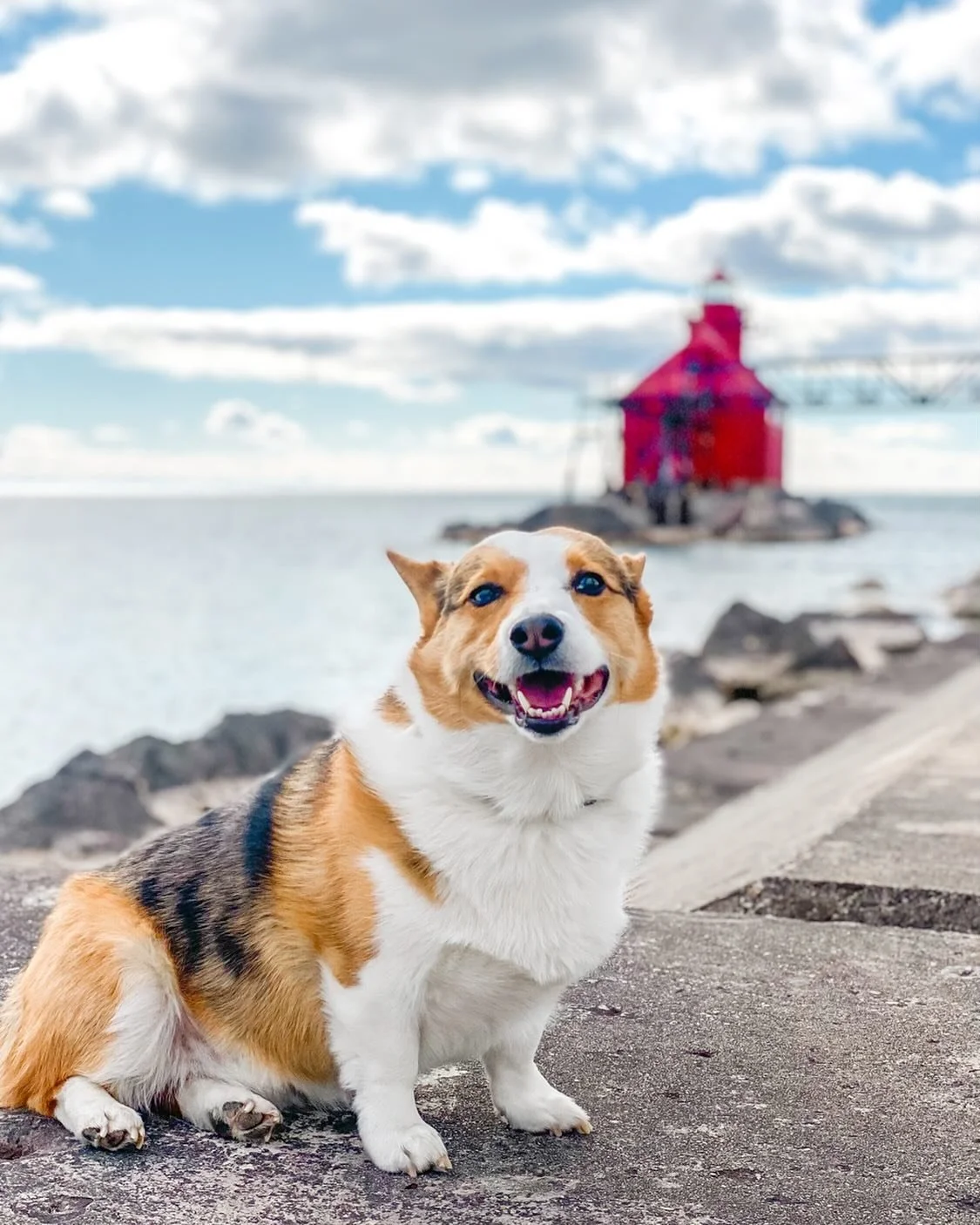

Heading to Door County for the first time? This complete first-timer’s guide covers when to go, where to stay, what to eat, and the must-do stops.