

Beginner's Guide to Fishing in the Milwaukee Area: Gear, Licenses, Lessons & Best Spots
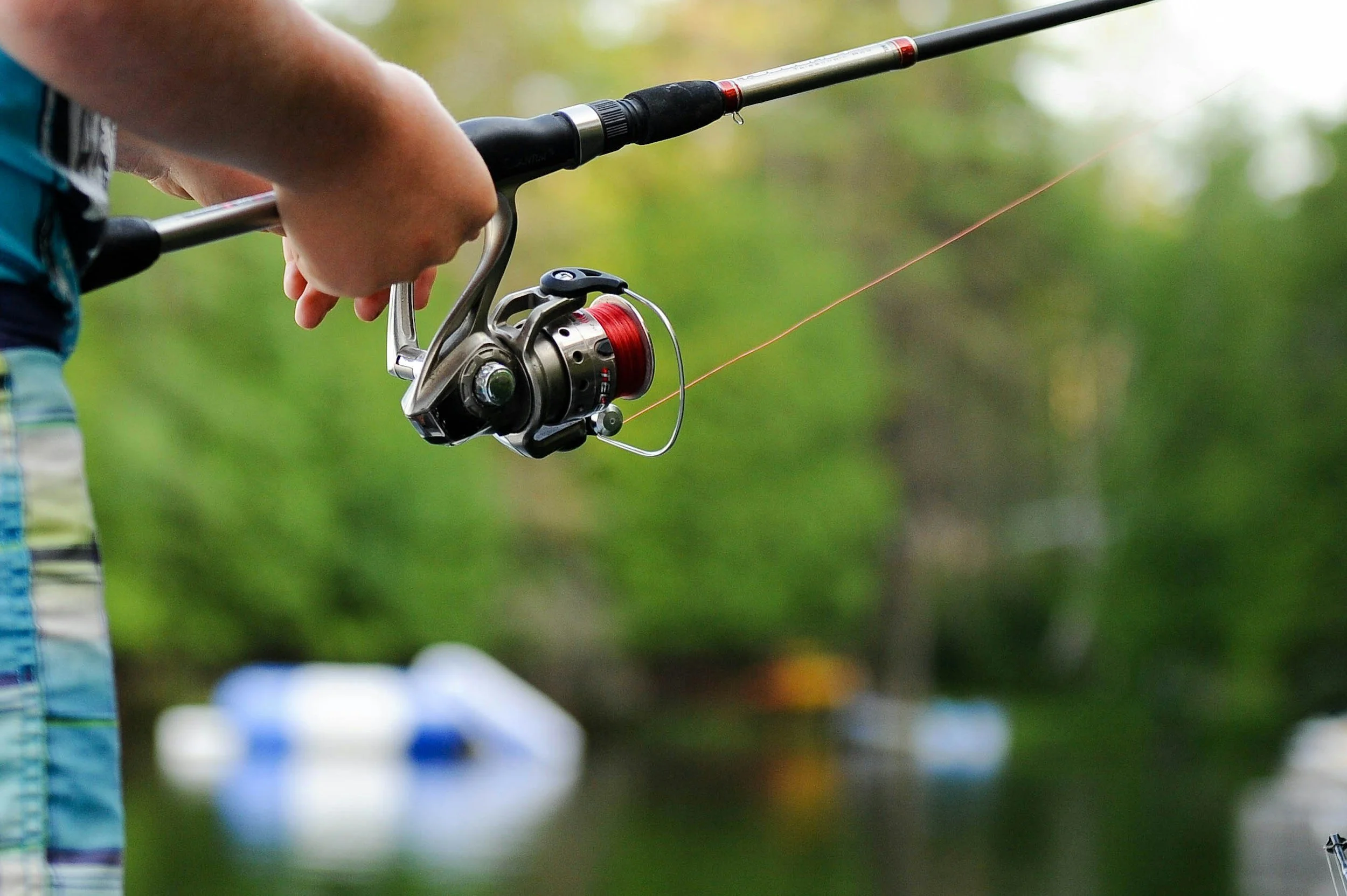
You can take your kids fishing in the Milwaukee area this weekend with a $20 license, a $5 bucket, and a container of worms — no boat, no experience, and no gear required.
Wisconsin lets every child under 16 fish free, hosts two license-free weekends a year (the next is January 16–17, 2027), and stocks more than 20 Milwaukee County ponds with rainbow trout each April. Within a 10-minute drive of the North Shore, families have access to a stocked lagoon, a fall salmon run dramatic enough to draw crowds, and a wooden pier on one of the Great Lakes. The rest of this guide tells you exactly where to go, what to buy, who will teach you, and what you will almost certainly catch.
A note on timing: the Wisconsin fishing license year runs April 1 to March 31, so anyone fishing in 2026 needs the new 2026‑2027 license. License fees have not changed since 2005, and a proposed increase in Gov. Evers's budget had not been enacted as of this writing.
Where to get your license
Wisconsin residents pay $20 for an annual fishing license, $8 for one day, or $31 for a spousal license that covers both partners. First-time buyers (or anyone returning after a 10-year lapse) pay just $5, seniors 65+ pay $7, and active-duty Wisconsin residents on leave fish free. The all-inclusive Conservation Patron license at $165 bundles fishing, hunting, all stamps, and a state park sticker — worth it only if you plan to hunt or visit state parks often. Non-residents pay $55 annually or $15 for a day.
Children 15 and under never need a license in Wisconsin, on any water, any day of the year. That single rule makes the state one of the most family-friendly fishing destinations in the country. Licenses are required starting at age 16, with a reduced $7 Junior rate for 16- and 17-year-olds.
Two stamps are worth knowing about. An Inland Trout Stamp ($10) is required only if you are targeting trout or salmon in inland streams or lakes — including the stocked rainbows in Milwaukee County park lagoons. A Great Lakes Trout & Salmon Stamp ($10) is required for targeting trout or salmon in Lake Michigan, in Milwaukee harbor, or anywhere on the Milwaukee, Menomonee, or Kinnickinnic rivers up to the first dam. If you are fishing for bluegill, bass, or perch, neither stamp applies — just the base license.
The easiest place to buy is Go Wild Wisconsin at gowild.wi.gov. You can also buy by phone at 1-888-936-7463, at the Milwaukee DNR Service Center (1027 W. St. Paul Ave., open weekdays 8:30–4:00), at any Fleet Farm or Walmart service desk, and at most local bait shops. Disabled, veteran, and free armed forces licenses must be purchased in person.
The 2026 Free Fishing Weekends were January 17–18, 2026 and June 6–7, 2026. The next is January 16–17, 2027, following DNR’s third-full-weekend-in-January schedule. License and trout/salmon stamp requirements are waived on most state waters, but bag limits, size limits, closed seasons and water-specific exceptions still apply.
Where to buy gear
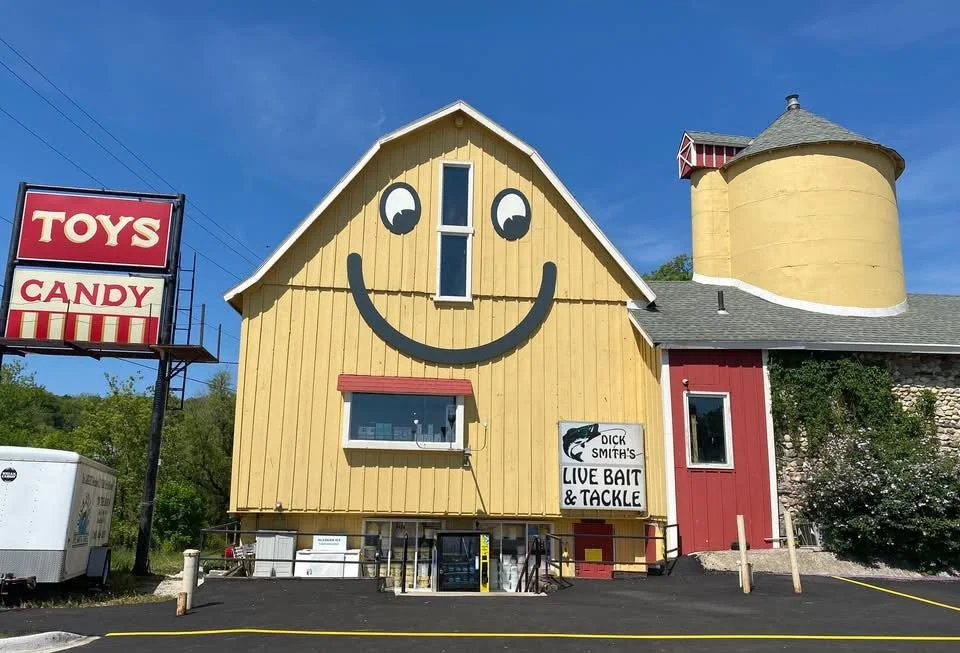
Dick Smith's Live Bait & Tackle
The single most beginner-friendly shop in the region is Dick Smith's Live Bait & Tackle at 2420 Milwaukee St. in Delafield, the red "Smiley Barn" visible from I-94. Open 365 days a year starting at 5 or 6 a.m., Dick Smith's has run as a family business since 1982, stocks what it calls the Midwest's largest live-bait selection, sharpens ice-auger blades, respools reels, and is genuinely patient with newcomers.
Inside the city, A & C Live Bait at 314 E. Center St. in Riverwest has filled a similar role since 1968, runs beginner clinics, and stays open until 10 p.m. on weekdays. For Lake Michigan tackle, R&R Sports Fishin' Hole at 3048 E. Layton Ave. in St. Francis is the 50-year institution; its hotline at 414-481-9090 will tell you what the salmon are biting. On Pewaukee Lake, Smokey's Musky Shop (N27 W27250 Woodland Dr., seasonal April–November) sits right at the public boat launch, and Beachside Boat & Bait at 129 Park Ave. rents boats and sells bait in the same stop. In Ozaukee County, Fat Boys Bait & Tackle at 228 N. Franklin St. in Port Washington specializes in Lake Michigan spawn sacks and salmon tackle.
For big-box shopping, Cabela's in Richfield (1 Cabela Way) is the regional flagship — 165,000 square feet with an aquarium, boat shop, licensing desk, and free seasonal clinics. Fleet Farm has SE Wisconsin stores in Germantown, Oconomowoc, West Bend, Muskego, and Plymouth, all selling chilled live bait and licenses at the service desk. Blain's Farm & Fleet runs stores in Oak Creek (501 W. Rawson Ave.), Waukesha (2310 Kossow Rd.), and Grafton (1771 Wisconsin Ave.). Dick's Sporting Goods operates in Brookfield, Wauwatosa (Mayfair Collection), Greendale, and Grafton. A 210,000-square-foot Scheels is under construction at Mayfair Mall with a Spring 2027 opening — not yet available. There is no Bass Pro retail store in the Milwaukee metro; the nearest showroom is Gurnee, Illinois.
A starter kit for a family of four, under $200
A complete first-time family kit costs roughly what a nice dinner out does. The workhorse is a Zebco 33 spincast combo ($20–$50) for young kids — one button, no tangles — paired with an Ugly Stik GX2 spinning combo ($60–$80) for adults and older children. A spinning rod is the single most versatile tool in freshwater, and the Ugly Stik is famously hard to break. Avoid baitcasting reels entirely at this stage; they are prone to bird's-nest tangles that will end the trip.
Your tackle box wants size 6–10 Aberdeen hooks for panfish, a pack of split-shot sinkers, red-and-white round bobbers kids can actually see, 6–8 lb monofilament line, and a few small barrel swivels. Add needle-nose pliers for unhooking, line clippers, a collapsible landing net, a five-gallon bucket (seat, fish holder, and gear tote in one), polarized sunglasses, and sunscreen. Nightcrawlers run $3–$5 per dozen, waxworms about $4 a cup, and small minnows $3.50–$5. For stocked trout, a jar of PowerBait or a handful of canned corn works shockingly well.
Best beginner spots
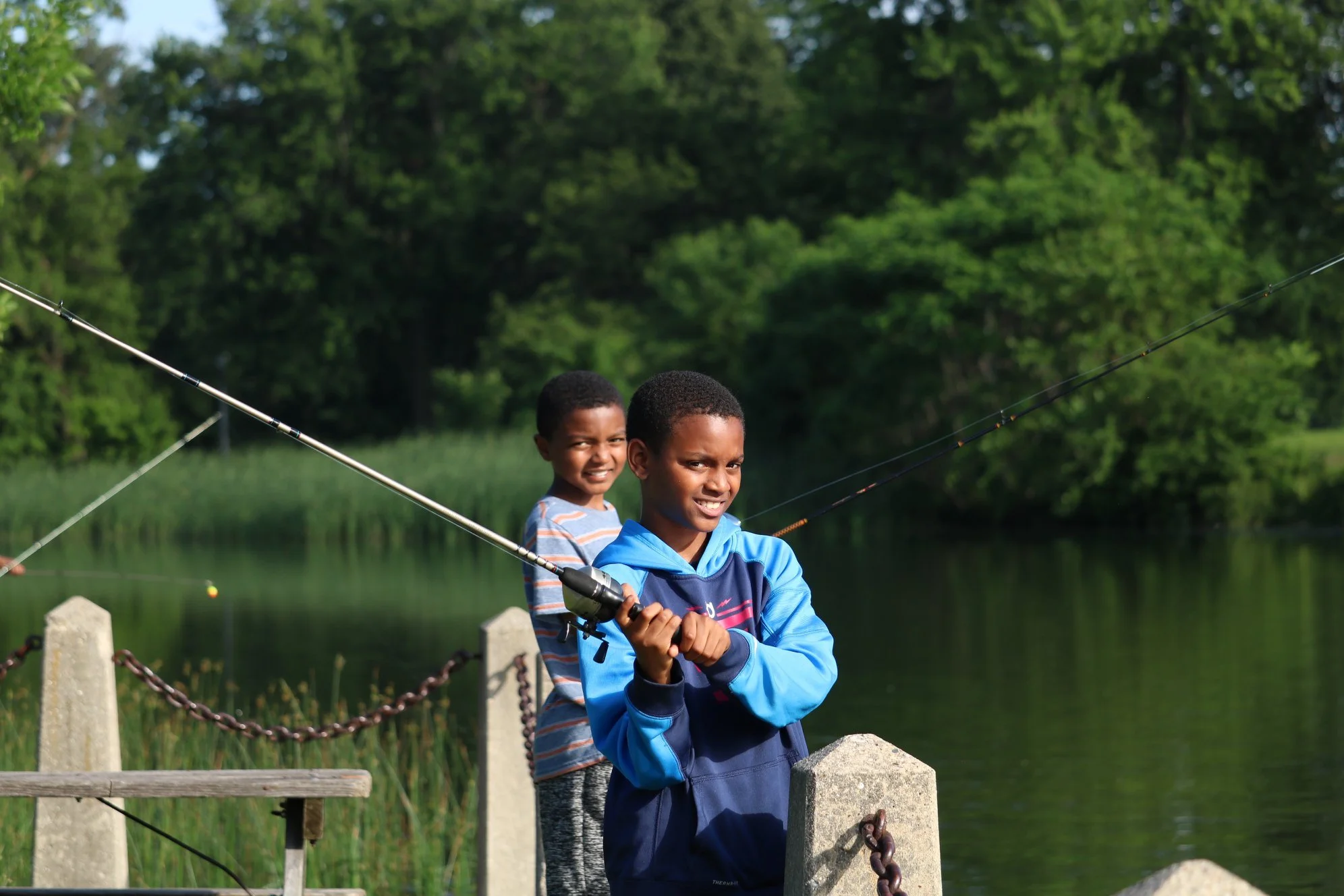
The goal for a first trip is a short walk, a railing, a nearby bathroom, and something that will bite a worm. These spots deliver.
Washington Park Lagoon (1859 N. 40th St.) is the best introduction in the city. The Urban Ecology Center on site loans rods and provides bait through its summer Fishing Club and Take It Outside Days. The lagoon receives DNR-stocked rainbow trout each April and holds bluegill, bullhead, and largemouth bass year-round.
Estabrook Park (4400 N. Estabrook Pkwy., right on the Milwaukee River between Shorewood and Glendale) gives you two fisheries in one: a stocked lagoon for toddlers and a dramatic riverbank below Estabrook Falls where salmon, steelhead, and smallmouth bass run. Estabrook Beer Garden on site makes this the rare fishing destination both kids and parents will want to repeat.
Kletzsch Park (6560 N. Milwaukee River Pkwy., Glendale) is the North Shore's iconic fall salmon spot. The dam and new fish passage draw spawning Chinook and coho from mid-September through early October — even if nothing bites, watching 20-pound salmon leap up the river is worth the trip. Fishing at the passage itself is restricted, so work the open shoreline downstream.
Hubbard Park (3565 N. Morris Blvd., Shorewood) has a staircase by the Hubbard Park Lodge leading to slow river eddies ideal for summer bluegill, plus salmon during the fall run — and an early-October Fish & Feather Festival every year.
Brown Deer Park Pond (7835 N. Green Bay Rd.) is the closest DNR-stocked urban pond to Bayside and River Hills, roughly 5–10 minutes away, and hosts one of the eight annual Spring Kids Fishing Clinics.
Klode Park and Big Bay Park in Whitefish Bay and Atwater Beach in Shorewood all give bluff-top access to Lake Michigan. The stairs are real — Atwater has a 50-step descent — but during spring and fall runs they produce coho, brown trout, and smallmouth bass from shore. Doctors Park in Fox Point (1870 E. Fox Lane) is a more serious hike to Tietjen Beach but remains the North Shore's premier brown-trout shoreline.
Lakeshore State Park (500 N. Harbor Dr.) is downtown and has what most North Shore parks don't: a paved, fenced, ADA-accessible fishing railing, a mono-line recycling tube, restrooms, and a protected lagoon full of bluegill, pike, and bass. A vehicle admission sticker is not required at Lakeshore State Park.
South Shore Park pier (2900 S. Shore Dr.) is the wood-decked, family-appropriate pier in Bay View — playground, restrooms, beer garden, and listed on the DNR accessible-fishing roster. Scout Lake (5902 W. Loomis Rd., Greendale) is Milwaukee County's only natural inland lake, the deepest of the stocked urban waters at 19 feet, and the site of a free kids' ice-fishing clinic each February.
For an inland-lake day trip, Pike Lake State Park in Hartford is the family package: accessible fishing pier, swim beach, and campground, 25 minutes northwest.
What you will actually catch, month by month
The most honest answer for a first trip: a bluegill on a worm under a bobber. Bluegill and other sunfish populate every lagoon, hit almost anything, and fight hard for their size. They are in season year-round, and Wisconsin's general panfish bag limit is 25 combined.
Spring brings yellow perch to McKinley Marina and South Shore piers, plus pre-spawn crappie to Scout Lake and Little Muskego. April is trout stocking month, when 20+ county lagoons receive yearling rainbows — Juneau Park received about 4,000 in 2025, Humboldt and McCarty roughly 2,250 each. The DNR Urban Fisheries Hotline at 414-263-8494 will confirm stocking dates.
Summer is bluegill and panfish weather. By July, smallmouth bass move onto the Milwaukee and Menomonee rivers (Estabrook, Hubbard, Hoyt Park), and carp prowl the lower Milwaukee River — a great species for teaching kids to fight a big fish.
Fall is the signature Milwaukee show. Chinook salmon peak mid-September through early October at Kletzsch, Estabrook, Hubbard, and the North Avenue dam site, followed by coho, fall steelhead, and lake-run brown trout through November. Runs depend on rainfall; arrive early morning on weekdays if possible.
Winter fishing moves to inland lakes — never Lake Michigan ice, which breaks free unpredictably. Anglers visit Pewaukee, Okauchee, Little Muskego, Pike Lake and the Cedar lakes in winter, but ice thickness alone does not establish safety. Wisconsin DNR warns that no ice is 100 percent safe and does not monitor local ice conditions. Check conditions locally and avoid unfamiliar ice, currents and pressure cracks. Harbor brown trout fishing at Jones Island and the Summerfest lagoon is considered world-class December through February, but that's a pursuit for more experienced anglers.
Regulations you need to know
Wisconsin's general inland fishing season for gamefish opens May 2, 2026, and runs through March 7, 2027. Panfish — bluegill, sunfish, crappie, perch — are open year-round on inland waters. Bass in the Southern Zone (which includes all of greater Milwaukee) have a continuous catch-and-release season, with harvest allowed May 2 through March 7. Check each species and water-specific season before fishing. The general inland musky season runs May 2–December 31, 2026, on open water only.
The bag and size limits most families will encounter are straightforward. Panfish are 25 combined per day with no size minimum on most waters. Largemouth and smallmouth bass: five combined, 14-inch minimum. Walleye: three per day, 15-inch minimum on most waters. Northern pike: five per day. Lake Michigan yellow perch: five per day, with a closed season May 1 through June 15 for spawning. Trout and salmon on Lake Michigan: five combined with species sub-limits. Always check the specific water on the DNR lake search tool before keeping fish — many Milwaukee lakes have exceptions.
One important 2026 change: the DNR has moved the inland trout season opener to April 4, 2026 (running through October 15), a departure from the traditional first-Saturday-in-May opener. Verify before you fish a trout stream.
For boats, every person needs a Coast Guard–approved life jacket, and children under 13 must wear one whenever the boat is underway on federally controlled waters, including Lake Michigan and the lower Milwaukee River. Anyone born on or after January 1, 1989 must complete a boater safety course before operating a motorboat.
Catch and release is easiest when you wet your hands before handling the fish, keep it out of water less than 30 seconds, support the belly on anything over a pound, and pinch down your hook barbs. Never grab a fish by the gills.
Lessons, clubs, and kids' derbies
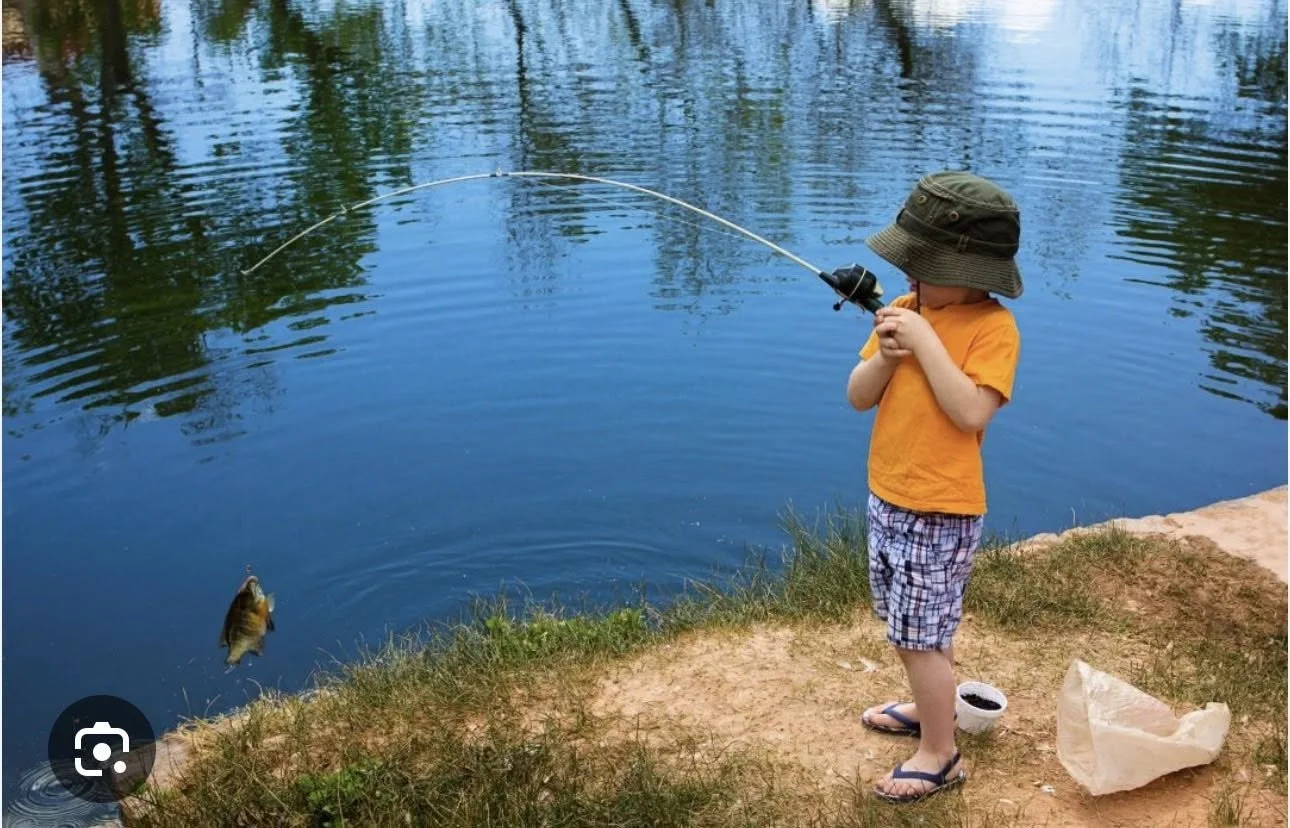
Photo via Milwaukee Sport Fishing Club
Three programs are genuinely worth building a family calendar around.
The Milwaukee County Spring Fishing Clinics are a 40-year tradition hosted at eight parks — Brown Deer, Dineen, Greenfield, McCarty, Mitchell, Sheridan, Scout Lake, and McGovern. Local fishing clubs staff each park with rods, bait, instruction, and prizes. Free, no registration required for families, aimed at kids 15 and under with an adult. The kids' ice-fishing clinic at Scout Lake runs the same format on the January Free Fishing Weekend.
The Urban Ecology Center operates a free summer Fishing Club at the Washington Park Lagoon (gear and bait provided), runs drop-in Take It Outside family fishing days at all three branches, and includes a fishing thread in its Menomonee Valley summer camps. Riveredge Nature Center (4458 County Hwy Y, Saukville) runs a Family Fishing program at Heron Pond for $7 non-members ($5 with a trail pass, free for all-access members), with all gear provided. Its free Community Rivers Program serves residents of Newburg, Saukville, Grafton, and Kewaskum.
The Wisconsin DNR Tackle Loaner Program gives you free rods and reels — no charge, no deposit — at the Urban Ecology Center Washington Park, Richard Bong State Recreation Area in Kansasville, and all three units of Kettle Moraine State Forest. A complete list is at dnr.wisconsin.gov/topic/Fishing/anglereducation.
Two area fishing festivals are family-friendly. The Shorewood Fish & Feather Festival at Hubbard Park in early October lets kids watch salmon spawning feet from the shore. Salmon-A-Rama in Racine, July 11–19, 2026, is free to attend, includes 13 bands, fireworks, a kids' fishing pond, and a family-oriented Sunday.
Local clubs worth knowing: Milwaukee Great Lakes Sport Fishermen (glsfclub.com) hosts Kids Day events and partners with Fishing Has No Boundaries; Southeastern Wisconsin Trout Unlimited (sewtu.tu.org) runs school programs and an annual youth fishing camp for ages 12–16; Salmon Unlimited of Wisconsin runs the Salmon-A-Rama kids' tournament; and Walleyes Unlimited anchors the Scout Lake clinics.
Chartering a Lake Michigan boat
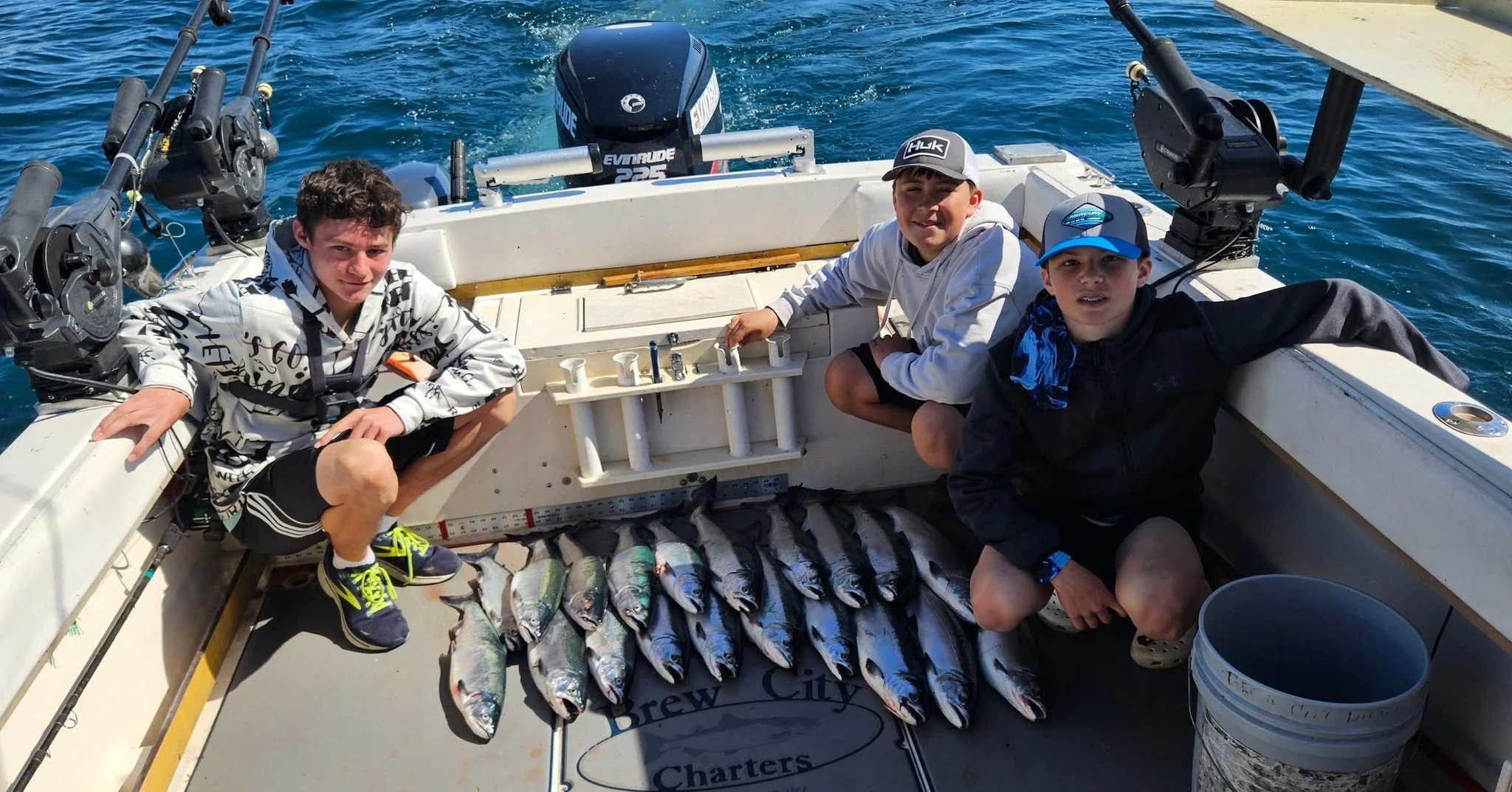
Brew City Charters
A four-to-six hour salmon charter out of McKinley Marina runs $550–$700 per boat for up to five passengers, which works out to roughly $100–$140 per person for a family. All tackle, fish cleaning, and bagging are included. On a charter, the captain is your instructor — use the trip as a crash course in downriggers, drag settings, and fish handling.
Three Milwaukee captains have strong beginner reputations:
Silver King Charters (Capt. Kurt and Willy Pokrandt, 414-460-1467) offers an April weekday special at $550 for six hours and a "no fish, no pay" guarantee on longer trips
Blue Max Charters (Capt. Jim, 414-828-1094) explicitly welcomes beginners but requires children to weigh at least 50 pounds
Brew City Charters (Capt. Todd) advertises children as welcome and runs multiple daily departures. All three will sell you a 2-day Great Lakes license onboard for $14.
Family trip-planning tips that actually work
A few lessons from parents who fish with kids regularly:
Keep the first trip under 90 minutes. Plan the post-fishing treat up front — Kopp's custard, the Estabrook Beer Garden, or a playground — so the departure is a victory, not a retreat.
Go right after the April trout stocking. Lagoons like Humboldt, Juneau, McCarty, and Scout Lake become near-guaranteed catch zones for two to three weeks.
Use bobbers for kids, always. Bottom fishing is invisible to a six-year-old; a bobber disappearing is a jolt of dopamine they will remember.
Pack water, snacks, hats, sunscreen, and bug spray for dusk lagoons. Use the PVC monofilament-recycling tubes at Lakeshore State Park and McKinley Marina rather than tossing line in the trash, where it tangles wildlife. On Lake Michigan piers, never turn your back on the water — sneaker waves are real, the water is cold year-round, and rocks are slippery. Keep small children six feet back from pier edges, and consider a life vest on any pier trip regardless of regulation.
The weekend plan for your first trip
Here is the shortest path from "we've never fished" to "we caught dinner." Buy a $20 annual license on gowild.wi.gov. This shore-fishing plan is intended for open-water weather; winter outings require separate planning and a local ice-condition check. Drive to Dick Smith's in Delafield (or A & C Live Bait on Center Street) and pick up a Zebco 33 combo, a dozen nightcrawlers, a pack of hooks, split shot, and two bobbers. Total out of pocket: about $40. Then head to Washington Park Lagoon, Estabrook Park Lagoon, Scout Lake, or Brown Deer Park Pond between 7 and 10 a.m., thread a worm, clip the bobber on two feet above the hook, cast five feet from shore, and wait. Within an hour, your kids will have caught their first bluegill — and Wisconsin's greater Milwaukee region, with its 2,000+ lakes, three urban rivers, and one Great Lake, will have opened up as the rest of your family's weekends.
Conclusion
Greater Milwaukee is one of the country's most underrated urban fisheries because its best family spots are hiding in plain sight — a stocked trout lagoon inside a Frederick Law Olmsted park, a fall salmon run ten minutes from River Hills, a public pier with a railing downtown. The barriers most families imagine are fictional: licenses are $20, kids fish free until 16, lessons are taught for free by retirees in April, and the bluegill does not care that you bought a $22 rod at Fleet Farm. The only real prerequisite is showing up. If a North Shore family tries one spot this year, make it Estabrook Park — a stocked lagoon for the smallest kids, a salmon river for the teenagers, and a beer garden for the parents, all within a single walk. Fish with your license, fish with your kids, and keep the line recycling tubes full. The region has been waiting for you.

Discover Forest Home Cemetery's fall events in Milwaukee and guided historical tours through November at Wisconsin's oldest cemetery and accredited arboretum.