

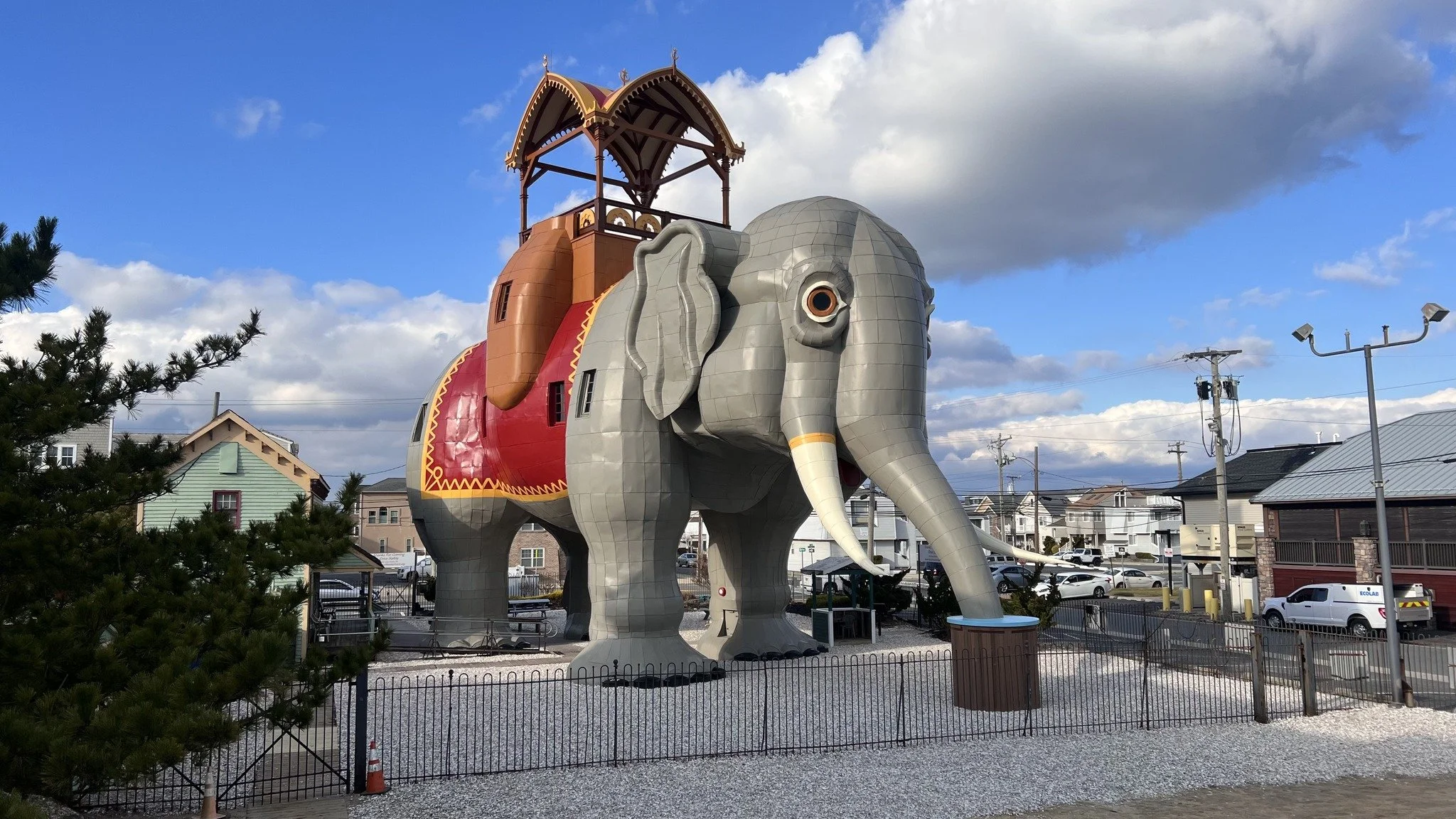
Lucy the Elephant – Margate, New Jersey
Somewhere out on an American highway right now, a family is pulling off the interstate to take a photograph next to a forty-foot rocking chair. Another family is climbing inside a fully functional mailbox the size of a tool shed. Someone is spray-painting a 1959 Cadillac that's been buried nose-first in a Texas wheat field for half a century.
This is the magic of the American roadside attraction, that singularly American genre of weirdness that turns ordinary highway miles into something you'll still be telling stories about years later. The country is generously stocked with these places. Some are sincere monuments to local pride. Some are unapologetic tourist traps that have earned their fame through sheer audacity. Many are folk art masterpieces built by individuals who simply could not stop building.
Whether you're planning a cross-country epic or just looking to make the next family trip more interesting, here are forty roadside attractions that prove getting there really is half the fun.
The Great American Roadside Bucket List
Forty quirky, gigantic, and slightly ridiculous stops worth pulling off the highway for. Tap any pin to learn more, or filter by region to plan your next road trip.
Tip: Click any pin for details, photos coming soon, and a one-tap link to driving directions.
The Northeast
The Northeast is home to some of the oldest surviving roadside attractions in America, many dating to the late nineteenth and early twentieth centuries. These were the original tourist traps, built to lure families heading to the shore or to the country.
1. Lucy the Elephant – Margate, New Jersey
Built in 1881 as a real estate marketing gimmick, Lucy is a six-story wood and tin elephant on the Jersey Shore and the oldest surviving example of zoomorphic architecture in the United States. Over her long career, she's been a tavern, a summer home, and a museum. Today she's a National Historic Landmark, and yes, you can still climb up inside her and look out over the Atlantic from the howdah on her back.
2. The Paper House – Rockport, Massachusetts
In 1922, mechanical engineer Elis F. Stenman set out to test the insulation properties of newspaper. Twenty years later, he had a fully built house with walls and furniture made from approximately 100,000 rolled and varnished newspapers. You can still read some of the headlines. The desk is allegedly made of papers covering Charles Lindbergh's flight.
3. The Big Duck – Flanders, New York
Built in 1931 by a duck farmer who wanted to advertise his poultry, this twenty-foot-tall duck-shaped building gave architectural critics a whole new vocabulary. "Duck architecture" is now a recognized term for any building whose form is entirely subordinate to its symbolic function. Lucy the Elephant is a duck, technically. So is every doughnut shop shaped like a doughnut.
4. The Thomas Edison Memorial Tower and World's Largest Light Bulb – Edison, New Jersey
A 13-foot light bulb sits atop a 117-foot concrete tower at the site where Thomas Edison perfected the first practical incandescent bulb. It's a fitting memorial to one of the most photographed inventions in human history.
The South: Folk Art, Faith, and Extraordinary Retail
Southern roadside attractions tend to feel more handmade and personal, often the work of single individuals who labored over years or decades. The South is also where you'll find some of the most uniquely American retail experiences in the country.
5. Coral Castle – Homestead, Florida
One of the strangest engineering feats in America. A Latvian immigrant named Edward Leedskalnin spent nearly thirty years (1923 to 1951) single-handedly carving and arranging more than 2.2 million pounds of coral rock into a castle complex, working mostly at night and refusing to let anyone watch. He never explained how he moved the massive stones, including a nine-ton gate that pivots so smoothly a child can push it open. The mystery is part of the appeal.
6. The Tree That Owns Itself – Athens, Georgia
According to local folklore, in the 1800s, a man named Colonel William H. Jackson loved a particular white oak so much that he deeded the tree the land it stood on. The original tree fell in 1942, but a "Junior" was planted from one of its acorns, and the legal eccentricity continues. It's a free, two-minute stop with a big story.
7. The World's Largest Peanut – Plains, Georgia
A 13-foot smiling peanut statue with President Jimmy Carter's distinctive teeth, built to celebrate the home of America's peanut-farmer-turned-president. It's catnip for political history nerds and small children alike.
8. Ave Maria Grotto – Cullman, Alabama
Brother Joseph Zoettl, a Benedictine monk with a tireless imagination, spent decades building 125 miniature replicas of famous religious shrines from around the world out of glass, marbles, sea shells, and donated materials. The result is a four-acre garden of tiny cathedrals, basilicas, and Holy Land sites that's quietly one of the most extraordinary folk art environments in America.
9. Unclaimed Baggage Center – Scottsboro, Alabama

The only retailer in the United States that buys and resells the contents of unclaimed airline luggage. After the airlines spend 90 days trying to find owners, the bags come here. The 50,000-square-foot store has sold everything from designer clothing to ancient Egyptian artifacts to a NASA space shuttle camera. It's a treasure hunt with a roof, and admission is free.
10. Miracle Cross Garden – Prattville, Alabama
The work of self-taught artist W.C. Rice, who covered his property with hundreds of hand-painted crosses and signs as a form of visual ministry. It's a haunting, beautiful, deeply personal example of the visionary folk art tradition that runs through the rural South.
11. Abita Mystery House – Abita Springs, Louisiana
A sprawling roadside museum filled with handmade dioramas, taxidermy oddities, and the famous Bassi-Gator (half-bass, half-alligator). It's deeply weird, deeply Louisiana, and exactly the kind of place road trips were invented for.
12. The World's Largest Red Ryder BB Gun – Rogers, Arkansas
Installed in 2021 outside the Daisy Airgun Museum, this 25-foot Red Ryder BB gun is a direct homage to the classic film A Christmas Story and a perfect example of a modern attraction earning its place in the canon.
The Heartland: Capital of Roadside Gigantism
The Midwest is the undisputed home of "World's Largest" attractions, where small towns have spent decades competing to put themselves on the map with comically oversized objects.
13. Casey, Illinois (12 Guinness World Records)
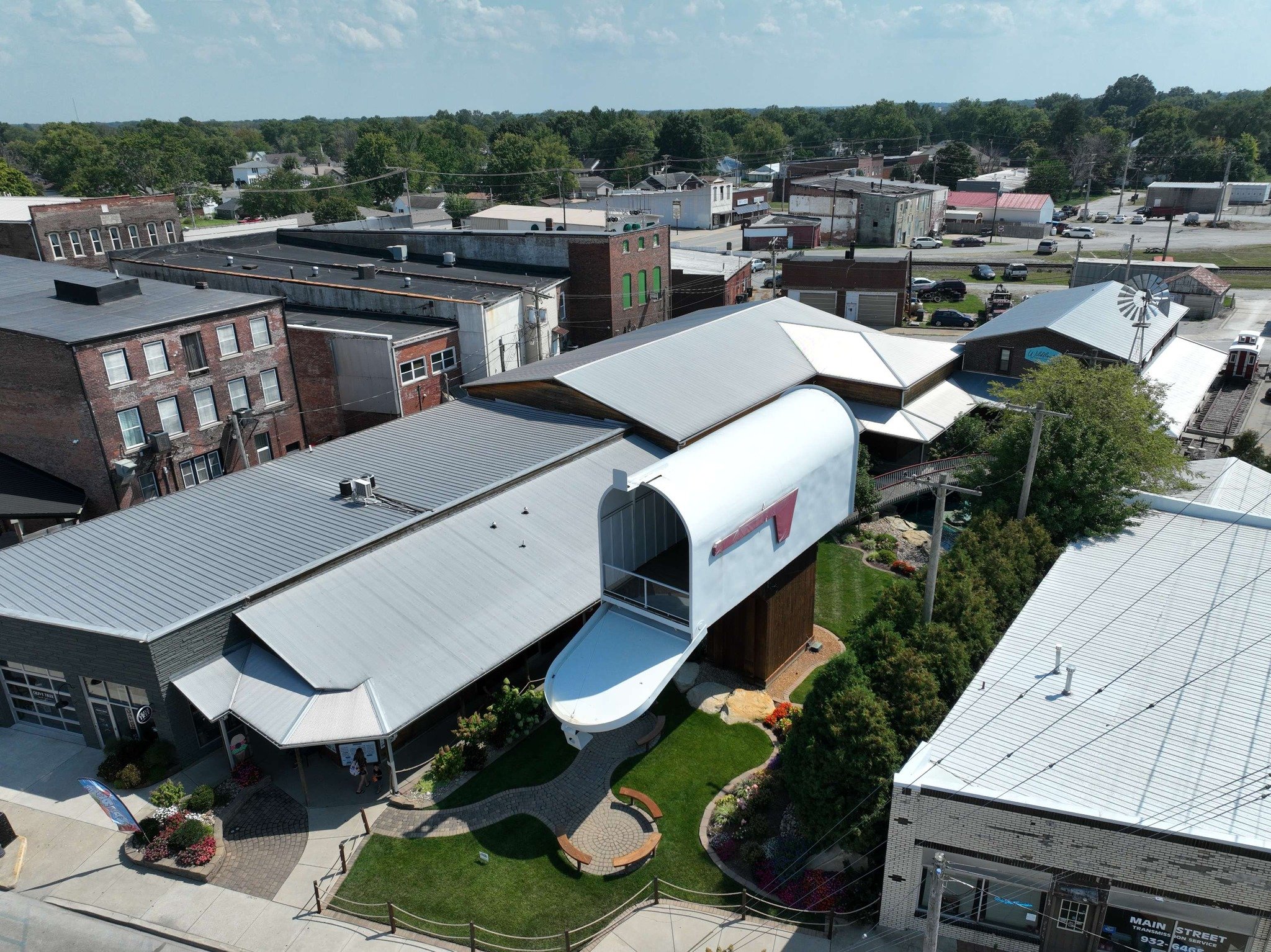
World's Largest Mailbox
This single small town has built an entire downtown economy around oversized objects. Casey holds twelve Guinness World Records, including the World's Largest Rocking Chair (56 feet tall), the World's Largest Mailbox (you can climb inside and send actual letters), the World's Largest Pitchfork, the World's Largest Wind Chime, and the World's Largest Knitting Needles. Unlike most roadside stops, Casey is a walking town. You park once and spend a few hours wandering between giants, which makes it an excellent stop for kids who need to burn off car energy.
14. The World's Largest Ball of Twine – Cawker City, Kansas
Started in 1953 by farmer Frank Stoeber, this twine ball now weighs more than 20,000 pounds and keeps growing because visitors are encouraged to bring their own twine and add to it. There's an annual "Twine-A-Thon" festival every August. (Note for completists: the twine ball in Darwin, Minnesota is the world's largest built by a single person. Cawker City's wins on weight and community participation.)
15. Carhenge – Alliance, Nebraska
In 1987, a man named Jim Reinders built a to-scale replica of England's Stonehenge using 39 vintage American cars, all spray-painted gray, half-buried nose-down in a circle. He'd lived in London, studied the original Stonehenge, and decided to honor his late father by combining the religion of England's ancient stones with the religion of the American highway. It's free, open dawn to dusk, and at sunset it looks like a postcard from another planet.
16. Wall Drug – Wall, South Dakota
The legend. During the Great Depression, Ted and Dorothy Hustead were watching their tiny pharmacy fail until Dorothy suggested putting up signs offering free ice water to travelers heading toward Mount Rushmore. The signs worked. They've never stopped working. Wall Drug today sprawls across a city block with a 530-seat restaurant, a roaring animatronic T-Rex, a giant jackalope kids can climb on, homemade donuts, and yes, still-free ice water. Two million people visit each year. It's seven miles from Badlands National Park, making it the perfect anchor for a Black Hills road trip.
17. Effigy Mounds National Monument – Harpers Ferry, Iowa
A solemn counterpoint to all the kitsch. More than 200 prehistoric burial mounds, many built in the shapes of bears and birds by Indigenous peoples over a thousand years ago. The visitor center is small and free, and the trails wind through some of the most beautiful bluff country in the upper Midwest.
18. The World's Largest Cowbell – Belle, Missouri
A 15-foot, 6,300-pound cowbell with a 350-pound crane ball as a clapper, installed in 2024 and absolutely capable of being rung. Proof that the great American "World's Largest" arms race is alive and well.
19. The Gateway Arch – St. Louis, Missouri
At 630 feet of stainless steel, the tallest monument in the United States and a tribute to the pioneers who pushed westward. It's also a working tram: tiny capsules carry visitors to an observation deck at the top with sweeping views of the Mississippi.
20. Superman Statue and Super Museum – Metropolis, Illinois
In 1972, the Illinois state legislature officially declared Metropolis the home of Superman, and the town has leaned all the way in. There's a 15-foot bronze statue of the Man of Steel in Superman Square, an annual Superman Celebration each June, and a Super Museum across the street with one of the largest collections of Superman memorabilia anywhere on Earth. If you have a comic-book kid in the back seat, this is a guaranteed win.
Route 66: The Mother Road's Greatest Hits
Route 66, established in 1926, remains the most iconic corridor for roadside attractions. Roughly 85 percent of the original road is still drivable, and the route serves as a living museum of mid-century automotive culture.
21. Lou Mitchell's Diner – Chicago, Illinois
The unofficial starting line of Route 66 and a Chicago institution since the early 1920s. They've been handing out free Milk Duds and donut holes to customers waiting in line for almost as long. It's on the National Register of Historic Places and remains a perfect launch point for any westbound road trip.
22. The Gemini Giant – Wilmington, Illinois
A 28-foot-tall fiberglass "Muffler Man" wearing a space helmet and holding a silver rocket. Originally built to advertise a now-closed restaurant called the Launching Pad, the Gemini Giant is one of the most beloved survivors of the Space Age roadside era.
23. Meramec Caverns – Stanton, Missouri
A vast cave system that became a roadside legend in part because its owner plastered billboards advertising the caves as far away as Europe. Tours run year-round through enormous chambers and rock formations. Famously, Jesse James is rumored to have used the caverns as a hideout.
24. The World's Largest Fork – Springfield, Missouri
A 35-foot fork weighing 11,000 pounds, planted in front of an advertising agency. It is exactly what it claims to be, and it is delightful.
25. The Blue Whale of Catoosa – Catoosa, Oklahoma
In 1972, a zoologist named Hugh Davis built a giant smiling concrete whale in a swimming hole as a wedding anniversary gift for his wife. The Blue Whale of Catoosa became one of the most photographed spots on Route 66 and remains a free, family-friendly stop with picnic tables nearby.
26. Ed Galloway's Totem Pole Park – Foyil, Oklahoma
A 90-foot concrete totem pole resting on the back of a massive turtle, built over eleven years by self-taught folk artist Ed Galloway using hundreds of tons of sand and cement. Surrounding it are dozens of smaller carvings and structures. It's a profoundly handmade place.
27. Cadillac Ranch – Amarillo, Texas
Created in 1974 by the art collective Ant Farm, this installation consists of ten Cadillacs (model years 1949 through 1963) buried nose-first in a wheat field. Visitors are encouraged to bring spray paint and add their own contribution. Bring old clothes. Kids absolutely love it.
28. The Wigwam Motel – Holbrook, Arizona
You can sleep in a concrete teepee. Built in the 1950s, this iconic motel features a row of 28-foot-tall wigwam-shaped rooms with vintage cars parked between them. It inspired the Cozy Cone Motel in the Pixar film Cars, and yes, you can still book a night here.
The Great River Road and the Plains
Some of the best roadside attractions are tucked along scenic byways rather than the interstate, rewarding travelers who take the long way.
29. Blue Hole – Santa Rosa, New Mexico
A circular, 80-foot-deep natural artesian spring that holds an eerie blue color and a constant 62-degree temperature year-round. It's a popular swimming and scuba diving spot in the middle of the high desert and feels like a portal to somewhere else entirely.
30. The Thing – Dragoon, Arizona
For decades, billboards along Interstate 10 between Texas and California have asked the same question: "What is The Thing?" The answer, available for a small admission fee at a roadside complex with a gas station and a Dairy Queen, is a perfect example of why families have been getting suckered into roadside mysteries since the dawn of the automobile. Bring quarters and a sense of humor.
The American West and Pacific Coast
The West offers some of the most spectacular natural scenery in America paired with some of its most idiosyncratic roadside culture.
31. Salvation Mountain – Niland, California
A massive desert hillside painted with thousands of gallons of lead-free paint and the phrase "God Is Love." Created by Leonard Knight over three decades using hay bales, adobe, and sheer faith, Salvation Mountain is one of the most photographed and otherworldly roadside stops in America. It's near the intentional community of Slab City, deep in the Imperial Valley, and a true pilgrimage spot for road-trippers.
32. Elmer's Bottle Tree Ranch – Oro Grande, California
A forest of trees made entirely from welded metal armatures and thousands of colored glass bottles, all built by folk artist Elmer Long. The bottles catch the desert sun and sing softly in the wind. It's free, it's surreal, and it's one of the most photogenic stops on the old Route 66 corridor in California.
33. The Madonna Inn – San Luis Obispo, California
A wonderfully bonkers hotel where every one of the 110 themed rooms is different. The Caveman Room is built entirely of stone. The Yahoo Room is decorated like a Wild West saloon. The men's room famously has a waterfall urinal that has to be seen to be believed. Even if you don't stay the night, stop in for pink champagne cake.
34. Hearst Castle – San Simeon, California
William Randolph Hearst's hilltop estate, with 115 rooms, two enormous swimming pools (the Roman-themed Neptune Pool is one of the most photographed pools in the world), and an art collection that rivals some museums. It's not exactly a roadside oddity but it is a gloriously over-the-top monument to American excess and worth every minute of the visit.
35. Bixby Bridge – Big Sur, California
One of the most photographed bridges in the world, a graceful concrete arch perched between two cliffs along the Pacific Coast Highway. There's nothing to do here except take a picture and stare at the ocean, which is absolutely the point.
36. The Mystery Spot – Santa Cruz, California
Since 1940, this small patch of forest has been bending visitors' brains. Balls roll uphill. People lean at impossible angles. The laws of physics seem to have been misplaced somewhere on the property. Whether you call it a gravity hill, a clever optical illusion, or genuine weirdness, kids find it delightful. Reservations are now strongly recommended on weekends.
37. Glass Beach – Fort Bragg, California
A stretch of coast that was used as a city dump in the early twentieth century. Decades of waves have tumbled the broken glass into smooth, jewel-like sea glass that now blankets the beach. Picking up the glass is technically prohibited (it's part of MacKerricher State Park), but walking among it is free and feels like beachcombing on another planet.
38. The Chandelier Drive-Thru Tree – Leggett, California
A 276-foot living redwood with a six-foot-wide tunnel carved through its base in the 1930s. Most family vehicles fit. The photos are nothing short of magical, and there are two other drive-thru redwoods (Klamath's Tour-Thru Tree and Myers Flat's Shrine Drive-Thru Tree) within a long day's drive if you're a completist.
39. Trees of Mystery – Klamath, California
A massive 49-foot Paul Bunyan and a 35-foot Babe the Blue Ox stand sentinel at the entrance to this redwood-themed park, which also includes a SkyTrail gondola through the canopy and the End of the Trail Museum. Paul Bunyan even talks to visitors, which is either charming or unsettling depending on your tolerance for animatronic lumberjacks.
40. Marsh's Free Museum and Jake the Alligator Man – Long Beach, Washington
A perfect Pacific Northwest cabinet of curiosities. The star attraction is "Jake the Alligator Man," a famous mummified hoax that has been a regional celebrity for decades and even appeared on the cover of Weekly World News. The town also boasts the World's Largest Frying Pan and the World's Largest Spitting Clam (a driftwood sculpture that actually shoots water), making Long Beach a genuinely productive afternoon for anyone who collects superlatives.
A Few Practical Tips
A few things worth knowing before you hit the road. Many of the best attractions are free or close to it, including Cadillac Ranch, Carhenge, the Blue Whale of Catoosa, Salvation Mountain, and Wall Drug itself, where you can browse for hours without spending a dime. Build these in generously when you're budgeting for a longer trip.
Many roadside stops are at their best at off-peak times. Sunset at Carhenge is a different experience than midday. Wall Drug is friendliest in early morning before the tour buses arrive. The Mystery Spot in Santa Cruz now requires advance reservations on weekends, and Hearst Castle tours frequently sell out, so check ahead.
Cluster your stops when you can. The Casey, Illinois objects are all within walking distance of each other. The Wall Drug area is also home to the Badlands and the Minuteman Missile National Historic Site, all within a fifteen-mile radius. The Route 66 stops in eastern Oklahoma can be done in a single day from Tulsa. The Pacific Coast Highway between San Luis Obispo and Mendocino is essentially one long string of attractions.
Bring a notebook. Older kids especially love keeping a road trip journal of the strange and wonderful things they've seen. There's something deeply satisfying about telling friends back home that yes, you really did stand under a forty-foot rocking chair, and yes, you really did add a piece of twine to the world's largest ball, and yes, you really did sleep in a concrete teepee in Arizona.
The American highway can feel impossibly long with a car full of kids. The roadside attraction is the country's gift to road-tripping families: a reminder that strange, sincere, slightly ridiculous things are still being built and maintained out there, mostly by people who just thought it would be fun.
Pull off. Take the photo. Buy the postcard. The trip is the point.

Costumes in Fish Creek, a Halloween parade in Sturgeon Bay, pumpkins in Ephraim and a haunted cornfield near Forestville: Door County has plenty of ways to celebrate spooky season.