

Wyalusing State Park: Your Complete Family Guide
Standing 500 feet above where the Wisconsin River meets the Mississippi, Wyalusing offers Wisconsin families one of the state's most historically significant and scenically stunning outdoor experiences. This 2,628-acre park—the fourth established in Wisconsin's state park system—combines dramatic bluff-top overlooks, family-friendly cave trails, excellent camping, and over 3,000 years of preserved Native American history. Whether planning a weekend camping trip or a day trip from Milwaukee, Wyalusing delivers something memorable for every age group. The park earned the 2018 Gold Seal Award for Best Eagle Watching and remains one of Wisconsin's most beloved natural treasures.
Park essentials: location, fees, and hours
Wyalusing State Park sits at 13081 State Park Lane, Bagley, WI 53801, approximately 7 miles north of Bagley and 6 miles south of Prairie du Chien in Grant County. The park occupies the dramatic bluffs at the confluence of the Wisconsin and Mississippi Rivers—the very spot where explorers Father Jacques Marquette and Louis Joliet first glimpsed this meeting of waters on June 17, 1673.
Getting there from Milwaukee: Take I-94 West to Madison, then US-18/151 West through Dodgeville, continuing on US-18 to Prairie du Chien. Turn south on County Highway C, then right on County Highway X for one mile to the park entrance. Total driving time: 3.5 to 4 hours (approximately 220 miles).
Park hours: Open year-round, 6 a.m. to 11 p.m. daily.
Entrance fees (2025):
Pass Type Wisconsin Residents Non-Residents Daily vehicle pass $8 $11 12-month annual pass $28 $38 Senior annual (65+) $13 N/A
Passes can be purchased at the park entrance, online at yourpassnow.com, or by phone. The annual pass pays for itself after three camping nights.
If you’re looking to save a few bucks, here’s how to get free admissions to Wisconsin state parks.
Why this park matters: history at the confluence
Wyalusing occupies some of the most historically layered ground in the upper Midwest. The park sits in the Driftless Area—the region that escaped glaciation during the last ice age—creating the dramatic 500-foot bluffs that define the landscape today.
Human habitation here stretches back 9,000 years. The park preserves 69 Native American burial mounds, including conical burial mounds, linear mounds, and effigy mounds shaped like bears, deer, and birds. The Sentinel Ridge Mound Group contains 28 mounds following the bluff crest, some dating to the Woodland Indians over 3,000 years ago. The Wyalusing State Park Mounds Archaeological District is listed on the National Register of Historic Places.
Beyond Native American significance, Wyalusing marks the precise location where European explorers first entered the Mississippi River watershed, forever changing the continent's history. A monument at Point Lookout commemorates Marquette and Joliet's arrival. The park also hosts the only monument in the United States dedicated to the extinct passenger pigeon, erected in 1947.
The Civilian Conservation Corps built the park's stone walls, overlooks, and many trails during the 1930s, and these structures remain architectural highlights today.
Choosing the best season for your family visit
Fall (September-October) stands out as the ideal season for families. Temperatures range from 32°F to 76°F, fall foliage creates spectacular views from the bluffs, bird migration brings diverse species along the Mississippi Flyway, and crowds thin compared to summer. Late September through mid-October offers peak color.
Summer (June-August) provides full access to all amenities: the concession stand opens, canoe and kayak rentals become available, and the astronomy center hosts evening star parties. Expect warm temperatures (60-83°F), high humidity, and active mosquitoes near the river. Campgrounds book solid—reserve 11 months ahead.
Spring (April-May) brings wildflower displays across the bluffs, excellent bird migration viewing, and fewer crowds. Water systems reactivate in spring, though trails may be muddy after rain.
Winter transforms the park into a cross-country skiing destination with 6.9 miles of groomed trails. The waterfalls at Pictured Rock Cave, Big Sand Cave, and Little Sand Cave freeze into beautiful ice formations. Eagle watching peaks during winter migration. Note that shower facilities close, though winter water remains available at one designated hydrant.
All hiking trails: detailed family breakdown
The park offers 14+ miles of hiking trails ranging from wheelchair-accessible overlooks to challenging 600-foot descents. Here's what families need to know about each:
Sentinel Ridge Trail (1.6 miles one-way)
This trail divides into two distinct experiences. The accessible loop section (0.5 miles) follows wide, crushed limestone through the Sentinel Ridge burial mounds with interpretive signs—perfect for strollers, wheelchairs, and toddlers. A bear effigy mound is visible along this path. The steep section descends 600 feet in three-quarters of a mile via wooden steps to the boat landing—challenging even for fit adults and unsuitable for young children. The Passenger Pigeon Monument sits along this route.
Sand Cave Trail (1.6 miles)
The best family hiking trail in the park. Children love exploring Big Sand Cave and Little Sand Cave—large cavities beneath sandstone overhangs with small waterfalls. The trail passes through forest with exposed roots and moderate slopes. Black Thunder Point between the caves offers excellent Wisconsin River views. Best for ages 5 and up who can handle uneven terrain. Dogs allowed. Rated 4.5 stars from over 670 reviews on AllTrails.
Sugar Maple Nature Trail (1.5-mile loop)
A self-guided interpretive trail with signs identifying plants and ecological principles. The highlight is Pictured Rock Cave, a waterfall tumbling over limestone (spectacular when frozen in winter). Multiple wooden stairways make this challenging for very young children. Note: dogs are NOT permitted on this trail. Best for ages 6+ with some hiking experience.
Bluff Trail (0.9 miles)
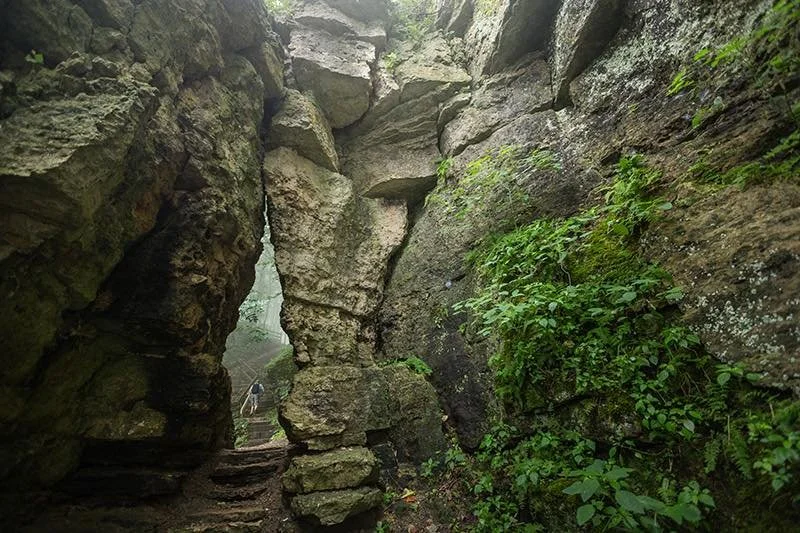
Follows the bluff rim with beautiful Wisconsin River views. Leads to Treasure Cave, accessible via a very steep wooden stairway and ladder—described by visitors as "built in a less risk-averse time." The trail passes "The Keyhole," a rock formation with a carved profile. The main overlook sections work for all ages, but Treasure Cave is only appropriate for confident climbers ages 8+. The cave may close seasonally to protect hibernating bats.
Mississippi Ridge Trail (1.8 miles)
Best easy trail for families with young children. Level terrain follows the bluff along the Mississippi River to Henneger Point picnic area, which sits 500 feet above the main river channel. Mountain biking permitted. Works for strollers on most sections.
Turkey Hollow Trail (2.3-mile loop)
Rolling terrain through open fields, brushlands, oak forests, and pine plantation offers excellent wildlife observation—wild turkeys commonly appear. The most diverse habitat trail in the park. Best for ages 6+ who enjoy nature watching. Also used for cross-country skiing in winter.
Whitetail Meadows Trail (1.7 or 3.1-mile options)
Easy, beginner-friendly trail along the boundary between woods and grassland. Excellent for deer and bird sighting. Starts from the Huser Astronomy Center parking lot. Great for younger children and serves as the primary cross-country ski trail in winter.
Old Wagon Road Trail (0.8 miles)
Originally built for wagons traveling from the blufftops to Walnut Eddy on the river. Steep descent into a canyon with a challenging climb back. Terminates at Knob Picnic Shelter overlooking the Wisconsin River. Best for athletic families and teens ages 10+.
Walnut Springs Trail (0.5 miles)
Short, easy connector trail from the Astronomy Center to Sand Cave Trail through grassland. Perfect for all ages and abilities.
Best trails sorted by age and ability
For toddlers and strollers:
Point Lookout (drive directly to paved viewing area)
Sentinel Ridge accessible loop (0.5 miles, flat crushed limestone)
Henneger Point (drive to overlook)
For young children (ages 4-7):
Sand Cave Trail (caves captivate kids)
Mississippi Ridge Trail (level, easy)
Whitetail Meadows (gentle terrain, wildlife)
For older children (ages 8-12):
Bluff Trail with Treasure Cave (exciting exploration)
Sugar Maple Trail (educational, waterfall)
Turkey Hollow (varied terrain, animals)
For teens and athletic families:
Full Sentinel Ridge Trail (challenging descent)
Old Wagon Road (steep workout)
Trail combinations creating 4+ mile loops
Point Lookout: the view you cannot miss
Point Lookout is the signature destination in the park and should be every family's first stop. Standing 500+ feet above the confluence of the Wisconsin and Mississippi Rivers, this CCC-built stone overlook provides panoramic views extending to Iowa's cornfields and the city of Prairie du Chien below. A monument to Marquette and Joliet marks the spot where European explorers first witnessed this landscape.
The overlook is fully accessible by car—park directly next to the viewing area. Wheelchair and stroller accessible. The stone walls provide safety, though supervision of young children is still essential near any bluff edge.
Fishing: rivers, backwaters, and what you'll catch
The park's location at the confluence of two major rivers creates outstanding fishing opportunities. The Mississippi River backwaters and Wisconsin River sloughs harbor diverse species in Pool 10 of the Mississippi.
Fish species available:
Excellent: Panfish (bluegill, crappie), largemouth bass, northern pike, walleye
Good: Smallmouth bass, catfish
Where to fish: The accessible fishing pier at the boat landing is ideal for families and those with disabilities. Shore fishing around the boat landing area provides easy access. For more adventurous anglers, the canoe trail accesses productive backwater areas.
License requirements: Wisconsin fishing licenses can be purchased online at GoWild.wi.gov, at DNR service centers, or retail license agents.
License Type Resident Non-Resident Annual $20 $55 1-day $8 $15 4-day N/A $29 15-day N/A $33 Junior (16-17) $7 Part of family license
Children 15 and under fish completely free—no license required. Wisconsin also offers free fishing weekends: the third weekend in January and the first weekend in June.
Camping options: two campgrounds with different personalities
Wyalusing offers 109 family campsites divided between two campgrounds with distinct characters. Both campgrounds feature gravel pads, picnic tables, and fire rings with grates. Book 11 months in advance for popular sites—new dates open daily at 9 a.m. CT.
Wisconsin Ridge Campground
Best for: Spectacular sunset views, proximity to amenities, dramatic scenery
This bluff-top campground delivers the most dramatic camping experience in Wisconsin. Sites along the outer ridge overlook both rivers from 500 feet, with sunset views across the valley. The campground sits near the playground, basketball courts, tennis courts, volleyball courts, concession stand, and main hiking trails.
Trade-offs: Sites are smaller and closer together, with less shade. Some outer ridge sites have minimal buffer between the campsite and bluff edge—something to consider with adventurous young children.
Best family sites: Sites 152-155 earn consistent praise for combining views with decent privacy. Sites 141 and 125 offer stunning Wisconsin River overlooks (125 is notably windy). Sites in the 120s and 140s generally provide the best vistas.
Homestead Campground
Best for: Privacy, shade, larger sites, families with young children
Set in a shady hardwood forest, Homestead offers approximately 55 larger, more generously spaced sites across four loops. A swing set and slide occupy the campground center. The 2018-built shower building receives consistently excellent reviews from campers.
Trade-offs: No river views, slightly farther from main attractions.
Note: All 9 electric sites in Homestead are non-reservable (first-come, first-served only). One ADA-accessible site is available.
Campsite pricing (2025 approximate ranges)
Site Type Residents Non-Residents Non-electric $15-22/night $20-27/night Electric $20-30/night $25-35/night
Additional fees: $7.95 reservation fee per site, plus required vehicle admission sticker. Minimum 2-night stay for advance reservations; 3-night minimum on holiday weekends.
Campground amenities
Modern shower buildings at both campgrounds (water systems shut down mid-late October through spring)
Dump station near Homestead entrance
Firewood, ice cream, and basic groceries at Bluff Top concession stand (late May through October)
Playground at Wisconsin Ridge
Sports courts near Wisconsin Ridge
Group camping options
The Hugh Harper Indoor Group Camp accommodates organized groups of up to 108 people in four heated dormitory buildings with bunk beds, a commercial kitchen, and dining hall. Two of four dorms are fully ADA-accessible. Reservations accepted by mail or in person only (no online booking). The Outdoor Group Camp offers 5 sites for up to 130 people total.
Important: The park does not offer cabin rentals for individual families. The only indoor option is the group camp, which requires minimum 2-night stays and advance mail-in reservations.
Water activities: paddling the Mississippi backwaters
Canoeing and kayaking
A 6-mile marked canoe trail winds through Mississippi River backwaters in partnership with the U.S. Fish and Wildlife Service. Blue and white signs mark all major intersections. The north route extends about 2 miles upstream; the south route reaches about 1 mile downstream before meeting the main Mississippi channel.
Wildlife viewing while paddling is exceptional: herons, egrets, bald eagles, barred owls, muskrats, and turtles frequently appear. The calm backwaters provide ideal family paddling conditions.
Rentals at the park concession stand: Approximately $10/hour or $25 for 4 hours. Rentals are not permitted on the main Mississippi channel or during unfavorable water conditions. Call ahead (608-996-2261) to confirm availability and water levels.
Boat launch
A boat ramp at the park accommodates motorboats and provides access to both rivers. Long Valley Road to the boat landing crosses railroad tracks—trains are fast and frequent. Stop, look, and listen before crossing.
Swimming
The park has no beach or swimming area. The nearest swimming access is Wyalusing Recreation Area, located 2 miles south of the park entrance, which offers a public beach, boat landing, and picnic area. Prairie du Chien also has a municipal swimming pool.
Bird watching along the Mississippi Flyway
Wyalusing's position on the Mississippi Flyway—a major North American migration corridor—makes it one of Wisconsin's premier birding destinations. Over 130 species have been recorded, with 90+ present during summer and 100+ additional species during spring and fall migration.
Specialty species worth seeking:
Yellow-throated Warbler (look in pine stands near Point Lookout)
Kentucky Warbler (Long Valley Road area)
Henslow's Sparrow (endangered—prairie habitat near Astronomy Observatory)
Prothonotary Warbler (nesting near boat landing)
Best birding locations:
Point Lookout pine stands for warblers
Long Valley Road (drive slowly) for forest specialties
Astronomy Observatory area for prairie birds
Park office feeders (winter—kept well-stocked)
Bluff edges for soaring eagles, hawks, and turkey vultures
Eagle watching peaks during winter when bald eagles concentrate along open water. The park's 2018 Gold Seal Award recognized this outstanding eagle-viewing opportunity.
Nature programs and the observatory
Lawrence L. Huser Astronomy Center
One of only two astronomy observatories in Wisconsin's state park system, the Huser Center features a 16-inch telescope and hosts free seasonal programs through The Starsplitters, a local nonprofit. Summer and fall "star parties" allow families to view celestial objects through the telescope. The park's position away from major light pollution creates excellent conditions for meteor shower viewing.
Interpretive programs
The park offers educational programs covering ecology, history, and Native American cultural significance. The Sugar Maple Nature Trail provides self-guided interpretation with informational signs. Contact the park office (608-996-2261) for seasonal program schedules.
Mound interpretation
The Sentinel Ridge accessible loop offers the most accessible introduction to the park's Native American burial mounds, with interpretive signs explaining the 3,000+ year history of human presence at the confluence.
Family activities beyond hiking
Playgrounds and sports: Wisconsin Ridge Campground features a playground, basketball courts, tennis courts, and volleyball courts. A swing set and slide occupy Homestead Campground's center. Ball fields are available near Hugh Harper.
Picnic areas: Multiple scenic picnic areas dot the park. Reservable shelters include Peterson Shelter (the only one with electricity), Green Cloud Shelter (excellent river views), Homestead Shelter, Henneger Point Shelter (500-foot bluff overlook), and Point Lookout Shelter.
Biking: The park offers 7.7 miles of mountain bike trails, including Whitetail Meadows and Mississippi Ridge trails. Park roads feature narrow, steep grades unsuitable for casual biking.
Geocaching: Multiple geocaches are hidden throughout the park—a popular family activity that encourages trail exploration.
Cave exploration: Four caves provide exciting destinations: Treasure Cave, Big Sand Cave, Little Sand Cave, and Pictured Rock Cave. Each offers a different character, from the dramatic waterfall at Pictured Rock to the large overhang at Big Sand Cave.
Winter activities: skiing, snowshoeing, and frozen waterfalls
The park remains fully open year-round, transforming into a winter wonderland when snow arrives.
Cross-country skiing: 6.9 miles of groomed trails accommodate both classic and skate skiing. All trails start from the Astronomy Center parking lot. Whitetail Meadows offers easier terrain for beginners; Turkey Hollow provides more challenging hills. Contact the park for current trail conditions. No pets or walking on ski trails.
Snowshoeing: All trails except designated ski trails welcome snowshoers. The Old Immigrant Trail and Bluff Trail Loop (3.5 miles, 652 feet elevation gain) offers particularly rewarding winter exploration.
Frozen waterfalls: Pictured Rock Cave, Big Sand Cave, and Little Sand Cave create spectacular ice formations during cold spells—unique photo opportunities accessible via maintained trails.
Winter camping: Available year-round at Wisconsin Ridge. A winter water hydrant operates east of the shower building. Shower facilities are closed during winter months.
Practical family information
Restroom facilities
Both campgrounds feature modern flush toilets and showers. The Wisconsin Ridge shower building includes an accessible bathroom and shower. Homestead's 2018-built facility earns excellent reviews. Vault toilets appear at various trailheads.
Seasonal closure: Water systems (flush toilets, showers, drinking fountains, dump station) shut down mid-to-late October and reopen in spring. Only the winter water hydrant at Wisconsin Ridge remains operational.
Accessibility
0.8 miles of wheelchair-accessible trails (Sentinel Ridge loop)
Accessible campsites at both campgrounds
Accessible fishing pier at boat landing
Point Lookout reachable by car with paved viewing area
Two of four Hugh Harper dormitories are fully ADA-accessible
Cell phone service
Coverage is inconsistent and varies by carrier and location. Some visitors report LTE/5G on US Cellular at the campground; others find no connection. Bluff-top areas may receive better signals. Download maps and trail information before arriving. The park office has a landline phone. Reliable coverage returns in Prairie du Chien (10 minutes away).
What to pack
Essential gear:
Sturdy hiking shoes (trails have steep sections, stairs, exposed roots)
Bug spray—multiple visitors emphasize this is critical, especially near water
Sunscreen and hats (bluff-top overlooks have significant sun exposure)
Binoculars (excellent bird watching)
Coast Guard-approved lifejackets for canoeing/kayaking
Fishing license (adults 16+)
Trail map downloaded or photographed (printed copies sometimes unavailable)
Bug awareness: Ticks pose the primary concern—blacklegged (deer) ticks carry Lyme disease. Wear light-colored long pants tucked into socks, stay on trail centers, and conduct thorough tick checks after hiking. Mosquitoes are heavy in summer, especially near the river. Poison ivy, poison oak, and poison sumac grow throughout the park.
Safety considerations
Bluff edges lack guardrails at some overlooks—supervise children closely
Some trails include 600+ feet elevation changes with steep stairs
The Treasure Cave ladder is very steep—only for confident climbers
Railroad tracks at boat landing crossing carry fast, frequent trains—stop and look before crossing
Keep food secured from raccoons (common in campgrounds)
Stay on designated paths near bluff edges (poison ivy present)
Nearby services in Prairie du Chien
Prairie du Chien lies approximately 10 minutes (6-7 miles) from the park entrance, providing all essential services.
Gas stations: Kwik Trip (multiple locations), Casey's, Shell, Love's Travel Stop (good for RVs)
Groceries: Walmart (1818 S Marquette Rd), Dollar General
Family-friendly restaurants:
The Porch — Pizza, burgers, 24 flavors hand-dipped ice cream; perfect post-hike stop
The Barn Restaurant — American fare, salad bar, eclectic décor, koi pond
Los Aztecas — Mexican, large portions, seasonal patio
The Blackhawk — Known for fried bluegill bites, downtown location
Jones Black Angus — Traditional Wisconsin supper club; reservations recommended
Medical facilities: Crossing Rivers Health offers full hospital services in Prairie du Chien.
Outdoor gear: Cabela's (1801 Cabela's Lane) is located in Prairie du Chien—convenient for forgotten supplies.
Nearby lodging if not camping
Prairie du Chien hotels (5-7 miles from park):
Hotel Best For Notable Features Country Inn & Suites Families with kids Indoor water park with 25-ft waterslide, free hot breakfast River District Hotel Downtown access Pool, hot tub, walking distance to shops AmericInn by Wyndham Comfortable stay Indoor pool, hot tub, courtyard fire pit Quality Inn & Suites Budget-friendly Indoor heated pool
Rates typically range from $51-$138/night depending on season and property. The Country Inn & Suites water park makes it particularly popular with families.
McGregor, Iowa (5 miles, across the Mississippi) offers charming downtown shops, galleries, and smaller lodging options near Effigy Mounds National Monument.
Nearby attractions worth combining
Villa Louis Historic Site
This National Historic Landmark features a beautifully restored 1870s Victorian mansion with 90% original furnishings. Located in Prairie du Chien, it offers guided tours with costumed interpreters, a Fur Trade Museum, and 25 acres of gardens. Open Wednesdays-Sundays, late May through late October. The War of 1812 battlefield on site adds historical depth. Contact: (608) 326-2721.
Effigy Mounds National Monument (Iowa)
Just 15-20 minutes from the park, this monument preserves over 200 prehistoric Native American burial mounds, including effigy mounds shaped like bears and birds. Admission is free. The popular Fire Point Trail (2 miles) climbs steeply (380 steps) to spectacular views. A Junior Ranger program engages children. The site is sacred ground—remind children about respectful behavior.
Pikes Peak State Park (Iowa)
Located across the Mississippi, Pikes Peak offers similar 500-foot bluffs with views of three rivers converging—a natural complement to Wyalusing. Visit the same day as Effigy Mounds for an Iowa exploration day.
Wyalusing Recreation Area
Two miles south of the park entrance, this area provides the nearest swimming beach, plus a boat landing and picnic area—useful since the main park lacks swimming facilities.
Day trip versus weekend: logistics for Milwaukee families
Can Wyalusing work as a day trip?
Technically yes, but barely. The 3.5-4 hour drive each way means 7-8 hours of driving plus limited exploration time. A day trip works if you:
Depart Milwaukee by 6-7 a.m.
Focus on Point Lookout, one short hike (Sand Cave Trail), and lunch
Accept you'll miss most of what makes the park special
Return home by 8-9 p.m.
The better choice: a weekend trip
Visitors consistently report that Wyalusing requires 2-3 full days to experience properly. A weekend trip allows hiking multiple trails, paddling the canoe trail, visiting Villa Louis or Effigy Mounds, and actually relaxing rather than rushing.
Suggested itineraries
Day trip (if you must)
5:30 AM — Depart Milwaukee
9:30 AM — Arrive park; get vehicle sticker and map
10:00 AM — Point Lookout and Passenger Pigeon Monument
10:30 AM — Sugar Maple Nature Trail with Pictured Rock Cave
12:00 PM — Picnic lunch at Green Cloud Shelter
1:00 PM — Sand Cave Trail (Big and Little Sand Caves)
3:00 PM — Ice cream at The Porch in Prairie du Chien
4:30 PM — Depart for Milwaukee
8:30 PM — Arrive home
Weekend trip (recommended)
FRIDAY
4:00 PM — Depart Milwaukee (avoid rush hour)
8:00 PM — Arrive Wyalusing; set up camp
Evening — Explore campground; campfire; check for astronomy programs
SATURDAY
7:00 AM — Early morning bird watching on bluffs
9:30 AM — Old Immigrant Trail and Bluff Trail Loop (3.5 miles)
12:30 PM — Lunch at camp or Green Cloud Picnic Area
2:00 PM — Canoe or kayak trip on Mississippi backwaters (2-3 hours)
6:00 PM — Dinner in Prairie du Chien (The Barn or The Porch)
Evening — Campfire and s'mores
SUNDAY
8:00 AM — Breakfast; break camp
9:30 AM — Drive to Effigy Mounds National Monument; hike Fire Point Trail
12:00 PM — Lunch in McGregor or Prairie du Chien
1:30 PM — Villa Louis guided tour
3:30 PM — Depart for Milwaukee
7:30 PM — Arrive home
If time is limited: top priorities
Point Lookout — The essential view; accessible by car
Sand Cave Trail — Family-friendly cave exploration
Sentinel Ridge accessible loop — Burial mounds and Passenger Pigeon Monument
Canoe trail — Unique Mississippi backwater experience (if time permits)
Essential planning reminders
Book campsites 11 months in advance — popular sites sell out immediately
Annual vehicle pass ($28 resident/$38 non-resident) saves money after 3+ nights
Children 15 and under fish free — no license needed
Pack serious bug protection — ticks and mosquitoes are abundant
Download maps before arriving — cell service is unreliable
Supervise children near bluffs — some overlooks lack guardrails
Call ahead for canoe rental availability — (608) 996-2261
Water facilities close mid-October through spring
Conclusion: a park worth the journey
Wyalusing State Park rewards families with experiences unavailable anywhere else in Wisconsin. Where else can children explore 3,000-year-old burial mounds, paddle through eagle-filled backwaters, discover caves with waterfalls, and stand exactly where Marquette and Joliet first saw the Mississippi—all in a single weekend? The drive from Milwaukee demands commitment, but the payoff is a genuine wilderness adventure layered with deep American history.
The park works for all family configurations: toddlers can enjoy Point Lookout and the accessible Sentinel Ridge loop while teens tackle challenging bluff descents. Campers can choose dramatic river views at Wisconsin Ridge or shady privacy at Homestead. Non-campers can base in Prairie du Chien and still access everything the park offers.
Book those campsites early, pack extra bug spray, and plan for at least two nights. Wyalusing has been drawing families to this confluence for over a century—and once you see the view from Point Lookout, you'll understand why.
Planning an Egg Harbor, Door County trip with kids? Our Milwaukee family guide covers the beach, the Fun Park, Plum Loco, dining, parks and where to stay.