

Can Trees Explode in Extreme Cold?
Why this viral winter claim keeps popping up—and what’s actually happening
Every winter, as temperatures plunge and wind chills dip into the truly unfriendly numbers, social media blooms with dramatic claims: “Trees are exploding in the cold!” Videos circulate. Photos get shared. Comment sections light up with equal parts awe and alarm.
It’s a great story. It’s also… not quite true.
Let’s unpack what’s really going on, because the reality is colder, quieter, and far more interesting than an exploding oak.
The short answer
No—trees do not explode in extreme cold.
But they can crack, split, or make very loud noises that sound a lot like explosions. And that’s where the confusion sneaks in.
What people are actually hearing
On bitterly cold nights, especially after a quick temperature drop, trees can make sharp, startling cracking sounds. These can echo across quiet neighborhoods and frozen parks, easily convincing someone that something dramatic just happened.
The culprit is physics, not botany having a bad day.
Inside a tree, water is stored in cells and fibers. When temperatures drop rapidly, that water freezes and expands. Wood, meanwhile, contracts in the cold. Expansion on the inside plus contraction on the outside creates stress. When that stress gets too high, the wood releases it suddenly—with a crack or split.
This phenomenon is often called frost cracking.
No flames. No shrapnel. No botanical fireworks.
Why it sounds like an explosion
Cold air carries sound more efficiently than warm air. Add a quiet winter night, frozen ground, and a sudden release of tension inside a tree, and you get a noise that can travel farther and sound sharper than you’d expect.
Your brain fills in the blanks. Social media fills in the drama.
Do trees get damaged?
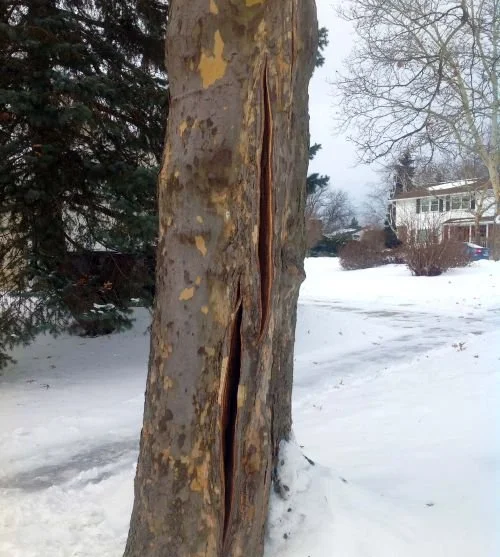
Photo: MSU Extension
Sometimes, yes.
A frost crack can split bark and wood along the trunk, creating a visible scar. Most healthy trees survive just fine, sealing the wound over time. Repeated cracking, however, can weaken a tree and make it more vulnerable to pests or disease later on.
Still, this is very different from a tree “exploding.” The tree remains firmly where it was, continuing its slow, stoic tree business.
Why misinformation spreads so fast in winter
Extreme weather primes us to expect extreme outcomes. When something sounds dramatic and looks mysterious—especially when paired with a grainy nighttime video—it spreads fast.
Social platforms reward surprise, not nuance. “Trees experienced internal stress fractures due to rapid thermal contraction” doesn’t travel nearly as well as “TREES ARE EXPLODING.”
The algorithm is allergic to context.
The takeaway
Trees don’t explode in extreme cold. They crack. They groan. They occasionally sound like they’re auditioning for a disaster movie. But what’s happening is a well-understood physical process, not a new winter horror unlocked by climate chaos.
Winter already has enough real challenges. We don’t need arboreal explosives added to the list.
Cold can be dramatic without being apocalyptic. And trees, even when they’re cracking under pressure, are still just trees—doing their best in a very unfriendly season.


Praesent id libero id metus varius consectetur ac eget diam. Nulla felis nunc, consequat laoreet lacus id.