

Grading Contractors: Homeowner's Guide to Fixing Drainage Around Your House
After back-to-back record-breaking rainstorms in Milwaukee — the August 2025 thousand-year event that flooded basements from Bayside to Bay View, and the April 2026 deluge that overwhelmed sewers all over again — a lot of North Shore homeowners are walking their yards after a downpour and asking the same question. Who do I call to fix the grading around my house?
If water is running toward your foundation instead of away from it, you're not imagining things, and you're not alone. The North Shore sits on heavy clay soil with a high water table influenced by Lake Michigan, under a housing stock dominated by 1920s-to-1950s homes with deep basements and grading that's had a hundred years to settle. Add in more frequent intense storms — MMSD itself notes its sewer system isn't designed to prevent street or yard flooding, meaning what happens on your lot is your problem to solve — and grading issues are showing up everywhere from Whitefish Bay to Mequon.
The good news is that fixing grading is one of the cheapest, highest-leverage repairs you can make on a home. Most jobs land between $500 and $3,000, which is dramatically less than interior waterproofing or foundation underpinning. The other good news is that the greater Milwaukee area has a deep bench of reputable contractors who do this kind of work well. Here's how to think about it, who to call, and what to expect.
First, confirm you have a grading problem
Before you start collecting quotes, take ten minutes to confirm the diagnosis. Industry consensus and most building codes call for the ground to fall at least six inches over the first ten feet from your foundation, which works out to about a five percent slope. Reuben Saltzman, the home inspector who runs Structure Tech, has put it plainly in Family Handyman: grading is a simple concept, but it plays a big role in preventing basement moisture, foundation cracks, mold, and rot, and good grading is one of the most effective and cost-efficient ways to protect a home from water damage.
You can check your own slope with a homeowner's version of the laser-transit survey a contractor will run. Drive a stake into the soil right against your foundation, tie a string at ground level, walk out ten feet, drive a second stake, and pull the string taut so it's level (a string level from any hardware store works). Then measure straight down from the level string to the ground at the ten-foot mark. You want at least six inches of drop. Less than that and you have a grading deficit worth fixing.
The visual signs are usually obvious once you start looking for them. Standing puddles within ten feet of the foundation after rain, spongy or marshy soil along the wall, damp basement walls or a musty smell after storms, white efflorescence powder on basement block, sticking doors and windows, settling patios or sidewalks, dead grass strips along the foundation, washed-out gullies under downspouts, and exposed foundation footings are all telling you the same thing: water is going the wrong direction. Step cracks in basement block walls or horizontal cracks are a more serious flag and warrant a call to a foundation specialist before you regrade.
A useful gut check is whether the problem is mostly water or mostly structural. If it's water, you're in grading-contractor territory. If walls are bowing, floors are sloping noticeably, or doors are jamming on multiple levels, get a foundation pro in the door first.
Specialists versus design-build firms
Greater Milwaukee's contractor market splits cleanly into two camps, and picking the right camp will save you money.
The first camp is drainage and grading specialists. These are the firms that show up with a laser transit, shoot the pitch of your lot, and design swales, drain tile, catch basins, downspout extensions, and EPDM foundation liners. They're focused on water, and water alone. If your only problem is that water is pooling in the wrong place, this is almost always the faster, cheaper route.
The second camp is design-build landscapers. These firms treat grading as one chapter of a bigger story that usually includes a patio, retaining wall, plantings, lighting, or driveway. They're the right call if you were already planning a yard renovation and the regrading is naturally folded into a larger redesign. You'll pay more, but you'll also get a coordinated project rather than a patch.
A common mistake is hiring a full-service landscape design firm to fix a $1,500 drainage issue, then spending $12,000 on a project that includes a new patio you didn't really need. Match the contractor to the actual job.
Contractors worth a call
The names below all serve the North Shore (Whitefish Bay, Shorewood, Fox Point, Bayside, Glendale, River Hills) and the broader Milwaukee metro, and all carry public review profiles you can verify yourself.
For pure drainage and grading work, the strongest specialist match is Integrity Drainage Solutions and its sister company Integrity Landscape Services, based in New Berlin and reachable at (414) 423-7900. Both companies are BBB-accredited, with a 4.8-star rating across roughly 98 reviews. They lead with precision laser-transit grading, swales, drain tile, catch basins, buried downspout and sump pump extensions, and EPDM rubber foundation liners, and their stated service area explicitly names Fox Point, Glendale, Shorewood, Whitefish Bay, River Hills, and Mequon. Reviews from North Shore customers describe exactly the work most readers will need — regrading on three sides of a house, replacing window wells, digging out buried downspouts, and dry basements after the work was done. They've also won twelve consecutive Angi Super Service Awards.
Terry's Excavating, Inc., founded in 1977 and reachable at (262) 968-4772, is the right call when the job is bigger and machine-driven. They're a Wisconsin licensed excavation contractor offering grading, basement waterproofing, foundation repairs, retention ponds and drainage ditches, erosion control, and retaining walls, and their service area covers Shorewood and broader Milwaukee County. Best for major regrades, drainage trenching, and driveway prep.
Best Choice Landscape, at 11820 W Ripley Ave in Wauwatosa, has been family-owned since the mid-2000s. Yelp shows them at roughly 4.5 stars across 101 reviews, and they offer a dedicated drainage, grading, and excavation service line including French drains, catch basins, and 3D CAD design renderings. Reach them at (414) 897-7922.
For design-build work, Oberndorfer Landscape Development in Mequon is a North Shore standby. They're a member of the Wisconsin Landscape Contractors Association and the Mequon-Thiensville Chamber, with a 4.7 overall rating on Angi and a service area that covers the entire North Shore. They have a dedicated yard-grading and lawn-leveling service page, and they're the right pick if your grading repair is going to roll into a larger landscape renovation.
LandCrafters, with offices in Wauwatosa at 7001 W Center St and in New Berlin (414-897-8232), is the awards-cabinet firm in the local landscape-design world. They've collected multiple Milwaukee NARI Gold awards, WLCA Gold and Judges' Choice awards, and an ASLA-Wisconsin Merit Award. Their portfolio specifically calls out drainage repair work — including a Wauwatosa Victorian where they used a series of interconnected rain gardens to capture all the downspouts and runoff. They're a strong fit when grading work overlaps with a larger design vision.
Stone Oak Landscapes in Cudahy, at (414) 253-9094, is another North Shore favorite. Founded in 1989, the firm has a 4.9 overall rating on Angi, and customer reviews specifically cite yard drainage, retaining walls, and French drain installation as services delivered well. Their service area includes Bayside, Fox Point, Shorewood, and Whitefish Bay.
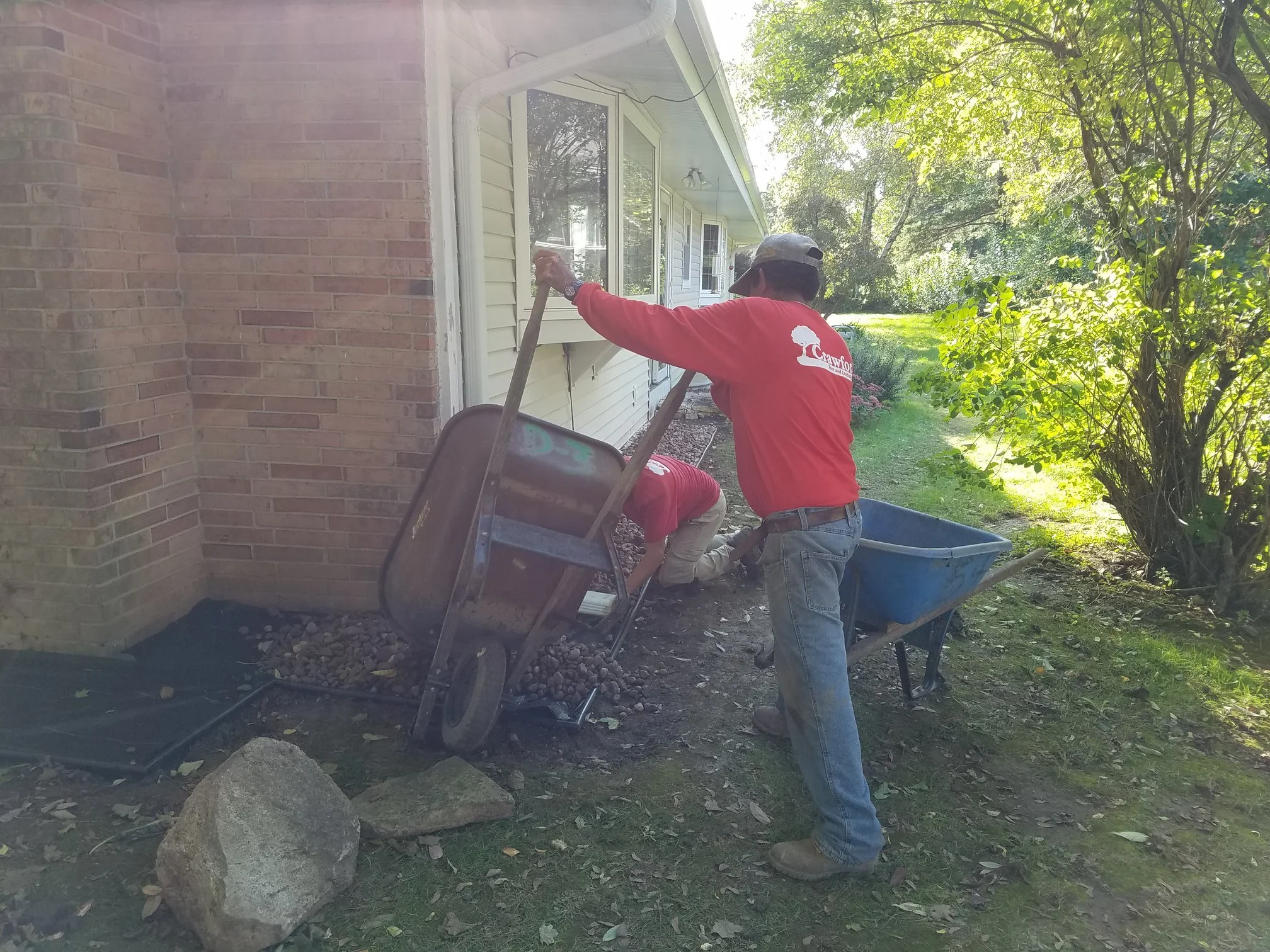
Crawford Tree & Landscape Services, at 8760 W Calumet Rd in Milwaukee (414-710-0093), has been family-owned since 1969 — over five decades of local work — and is TCIA-accredited with ISA-Certified Arborists and NALP-certified landscapers on staff. Their service area explicitly includes Bayside, Fox Point, Glendale, Shorewood, and Whitefish Bay. A standout customer review on their site describes drainage work that survived the August 2025 thousand-year storm with no flooding, and notes that Crawford's quote was the highest of four received, but their plan was the only one the homeowner felt sure would solve the problem at the root. They're the strongest fit for shaded clay-soil lots with mature trees, which describes a lot of Shorewood and Whitefish Bay.
Nic Ehr Landscape Co., in Glendale at (414) 352-9180, is the longest-tenured local option on this list. The firm has been family-owned since 1947, and while their online review footprint is smaller than the others, their multigenerational North Shore presence is hard to match. They're a particularly good call for smaller projects where neighborhood familiarity matters.
If your contractor diagnoses actual structural foundation movement — bowing walls, step-cracking beyond cosmetic, significant settling — the established Milwaukee-area foundation specialists are GSI Foundations in Germantown, American Foundation Specialists in Hales Corners (in business since 1947), JJB Home Improvements, and the Foundation Supportworks Milwaukee dealer. Worth noting: reputable drainage specialists actively warn against unnecessary structural waterproofing upsells. Integrity's own position is that most homes do not need extensive waterproofing or foundation repair that others often suggest, and that proper exterior grading is usually the first and cheapest fix. If a bid jumps straight to interior drain tile or wall anchors before anyone has talked about regrading, get a second opinion.
What it actually costs in 2025-2026
Pricing data from regional and national sources gives you a useful range for what a Milwaukee North Shore homeowner should expect to pay. Land grading runs roughly $0.40 to $2.00 per square foot. Fixing the grading immediately around a house typically costs $500 to $3,000, with a single ten-foot strip on one side closer to the $500 to $1,000 end and a full perimeter regrade on the higher end. A full backyard regrade lands in the $1,000 to $5,000 range. French drain installation runs about $10 to $35 per linear foot, and complete drainage systems with catch basins, buried downspouts, and discharge piping can run anywhere from $1,500 to $11,000 depending on complexity. Most contractors enforce a minimum charge of roughly $1,200 to $1,500, so don't expect a true small job to come in much under that.
These are ranges, not quotes. Get three written estimates and let the bids triangulate the real number for your lot.
What to ask before you sign
A serious contractor will welcome a checklist of questions. The ones that matter most cluster into four buckets: credentials, diagnosis, scope, and money.
On credentials, ask for the Wisconsin DSPS Dwelling Contractor and Dwelling Contractor Qualifier license numbers and verify them at license.wi.gov. Wisconsin requires both certifications for any contractor pulling a building permit on a one-or-two-family home, and standard Dwelling Contractors must carry liability insurance of at least $250,000 per occurrence and a $25,000 surety bond. Ask for a current certificate of liability and worker's comp insurance emailed directly. Ask whether the company is BBB-accredited and a member of the Wisconsin Landscape Contractors Association, NALP, or TCIA. Confirm who pulls permits — Whitefish Bay, Shorewood, Fox Point, Bayside, and Glendale all run separate permit offices — and confirm that 811 utility locates will be called before any digging.
On diagnosis, ask whether they'll do a laser-transit pitch survey of the lot before quoting. Ask for a written diagnosis of where the water is coming from: surface runoff, downspouts, the neighbor's lot, the high water table, or subsurface seepage. Ask what slope they'll create away from the foundation and whether it'll meet the six-inch-over-ten-feet minimum. Ask to see a sketch or 3D drawing of the proposed swale, grade, and pipe layout before the work starts. Ask whether the design diverts water through regrading and downspout extensions or collects it through catch basins and French drains, and why that's the right answer for your soil and lot. Ask where the water will ultimately discharge, and confirm the outlet is on your own property or a public storm system. Discharging onto a neighbor's lot is a frequent source of legal conflict in the North Shore and worth getting right up front.
On scope, ask what soil type they'll use as fill (it should be a clay-loam blend, not sand, which sends water straight to the foundation), how it will be compacted, and what's included for re-vegetation — sod versus seed, straw versus hay, fertilizer, watering instructions. Ask how they'll protect existing lawn, trees, irrigation, and hardscape during machine access. Ask for a start date, projected duration, and rain-day policy, and ask who the on-site foreman is and how to reach them daily.
On money, ask to see photos and addresses of three similar drainage and grading jobs they've done in the North Shore, and ask if you can call those references. Insist that the estimate be fully itemized — excavation, fill, materials, labor, permits, hauling, and restoration broken out as line items. Ask for the written warranty on workmanship, compaction and settlement, drainage performance, and plantings or sod. Ask for the deposit schedule (cap it at 30 percent in Wisconsin), what triggers final payment, and how change orders are handled if conditions turn out different than expected.
What a real estimate looks like
A legitimate North Shore grading or drainage estimate is rarely a one-line price. Expect a written scope describing the problem, the diagnosis, and the proposed solution in plain language — for example, regrading 24 feet along a south foundation to achieve a six-inches-over-ten-feet fall, building a swale to the property line, burying an east downspout in four-inch HDPE pipe with a pop-up emitter, and restoring the area with topsoil, seed, and straw.
Expect quantities — cubic yards of fill, linear feet of pipe, square feet of restoration. Expect material specifications including pipe type (Schedule 40 PVC or triple-wall HDPE), stone size, fabric type, soil mix, and seed or sod variety. Expect line-item pricing covering labor, materials, equipment and mobilization, disposal, permits, and restoration. Expect a schedule and payment terms with a deposit cap and progress milestones, an insurance certificate and license number included or referenced, warranty language at minimum covering one-season workmanship and explicit drainage performance, and photographs of access points and any pre-existing conditions so post-job disputes are limited.
Be deeply skeptical of the lowest bid if it lacks line items, the highest bid if it pushes interior basement waterproofing or foundation underpinning before exterior grading has even been tried, and any contractor who pressures you to sign on the spot or asks for more than 30 percent down.
A few Milwaukee-specific cautions
Don't bury siding. Code generally requires keeping new soil at least a few inches below the bottom of siding or top of foundation. Burying siding invites rot, ice damage, and termites.
Don't let anyone backfill with sand. Topsoil or a clay-loam blend is the right fill against a foundation. Sand allows water to migrate straight down to the foundation wall, which is the opposite of what you want.
Plan for winter. Buried perforated pipe can freeze in Wisconsin winters, which is why French drains should be designed as a secondary solution rather than the primary one. Good surface grading and properly extended downspouts do most of the work; subsurface tile is the backup.
Manage expectations after the August 2025 and April 2026 storms. The August 2025 event was officially classified as a 1,000-year storm, and no private grading project will fully prevent flooding under those kinds of conditions. The realistic goal is to keep water out of the basement under typical heavy rainfall and reduce damage during extreme events. A good contractor will tell you that up front.
A practical North Shore game plan
Start by walking your lot during the next heavy rain and photographing where water pools. Run the string-line test against the foundation. If the issue is purely surface water within ten feet of the house, you're almost certainly looking at a $500 to $3,000 grading and downspout fix, not a $15,000 waterproofing project — and that's where to start.
For pure water problems, get quotes from Integrity Drainage Solutions, Best Choice Landscape, and Terry's Excavating. For grading combined with a new patio, retaining wall, or full landscape redesign, get quotes from LandCrafters, Stone Oak Landscapes, and Oberndorfer, and add Crawford Tree if mature trees are involved. For a small, neighborhood-scale job in the heart of the North Shore, Nic Ehr Landscape in Glendale is hard to beat.
Verify every contractor's Wisconsin DSPS license at license.wi.gov, get three line-itemed bids, demand written drainage-performance warranties, and don't release final payment until you've watched the lot through a real rainstorm. Grading isn't glamorous, but on a Milwaukee clay-soil lot, it might be the single best thousand dollars you spend on your home this year.

Water pooling near your foundation? Here's a North Shore homeowner's guide to the best grading and drainage contractors in greater Milwaukee, plus real costs and what to ask before you sign.