

Armory Park: Whitefish Bay's historic green space

Armory Park is the living legacy of more than a century of military service, community gathering, and civic identity in Whitefish Bay, Wisconsin.
Situated at the southwest corner of Henry Clay and Ardmore Avenue, this approximately six-acre park sits on land that has been central to the village since 1870. Today, it hosts a Veterans Monument and Memorial Garden honoring 56 service members, serves as the home field for youth T-ball, and functions as one of the last large, uninterrupted green spaces in this landlocked Milwaukee suburb.
It now faces an existential threat: a $135.6 million school referendum on the April 7, 2026 ballot would build a new three-story middle school directly on the park site, a proposal that has ignited fierce community debate and the formation of the grassroots Save Armory Park campaign.
From a German immigrant's farm
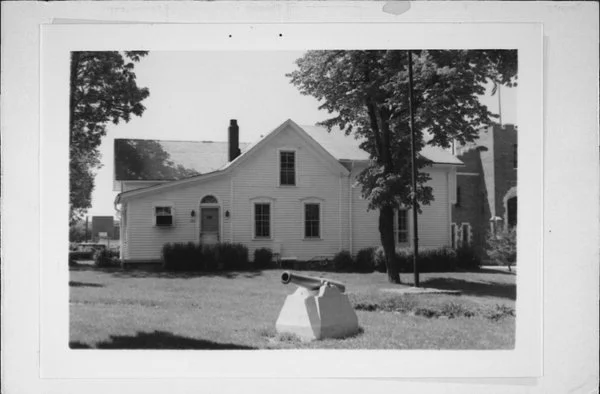
Friedrick Gustave Rabe House. Photo via Wisconsin Historical Society
The story of Armory Park begins in 1870, when German immigrant Friedrick Gustave Rabe purchased a 19-acre plot and built a white frame farmhouse for his wife and two daughters. The property stretched from Henry Clay Street south to Fairmount Avenue and from Ardmore Avenue west to Marlborough Drive. After Rabe's death, Otto Falk — vice president of the Falk Corporation and a prominent Wisconsin National Guard officer — acquired the land.
Military use of the site began in 1908, when the 57th Field Artillery Brigade relocated from downtown Milwaukee and began drilling on what was still farmland. The Rabe farmhouse served as headquarters, and three different commanding officers and their families lived there over the years. A colorful chapter unfolded in 1914 when the nearby Pabst Whitefish Bay Resort closed: its train depot was moved to the armory site and converted into a drill hall, while its dance hall became a soldiers' storage locker building.
The site's signature structure arrived in 1928–1929 with the construction of the red brick armory building, designed by the prolific Milwaukee firm Martin Tullgren & Sons in the Late Gothic Revival style. Featuring a crenelated roofline, central tower, terrazzo corridors, a gymnasium, and a mammoth fireplace in an officers' lounge, it was called "the finest armory in the state."
Up to 500 guard members drilled there on training weekends. The building served Battery A of the 121st Field Artillery, which was part of the famed 32nd Infantry Division — the "Red Arrow Division" — so named because it pierced every enemy line it faced. Units stationed at the armory served in the Mexican Border War (1916), World War I (including six major campaigns such as Meuse-Argonne and Aisne-Marne), World War II (both Pacific and European theaters), and the Korean War.
In 1927, 13 acres were sold to the village for the construction of Whitefish Bay High School, which opened in 1932. Architect Tullgren designed both the high school and the armory, along with the village hall and several elementary schools — including Henry Clay School (now Whitefish Bay Middle School), which plays a central role in today's referendum debate.
Beyond military operations, the armory became an unofficial community center. Nicknamed "Bay's Back Door" during the 1940s, it hosted weddings, proms, church services, basketball tournaments, police balls, and the activities of more than 30 community groups. Local 16-year-olds took their driver's license exams in its classrooms for years.
The Village of Whitefish Bay purchased the property in 1995. After public hearings, the decision was made in 1998 to raze the buildings for park use. The Rabe farmhouse was demolished in 2000, and the armory building came down in 2004, giving birth to what we now know as Armory Park.
Veterans Monument tells the Red Arrow story
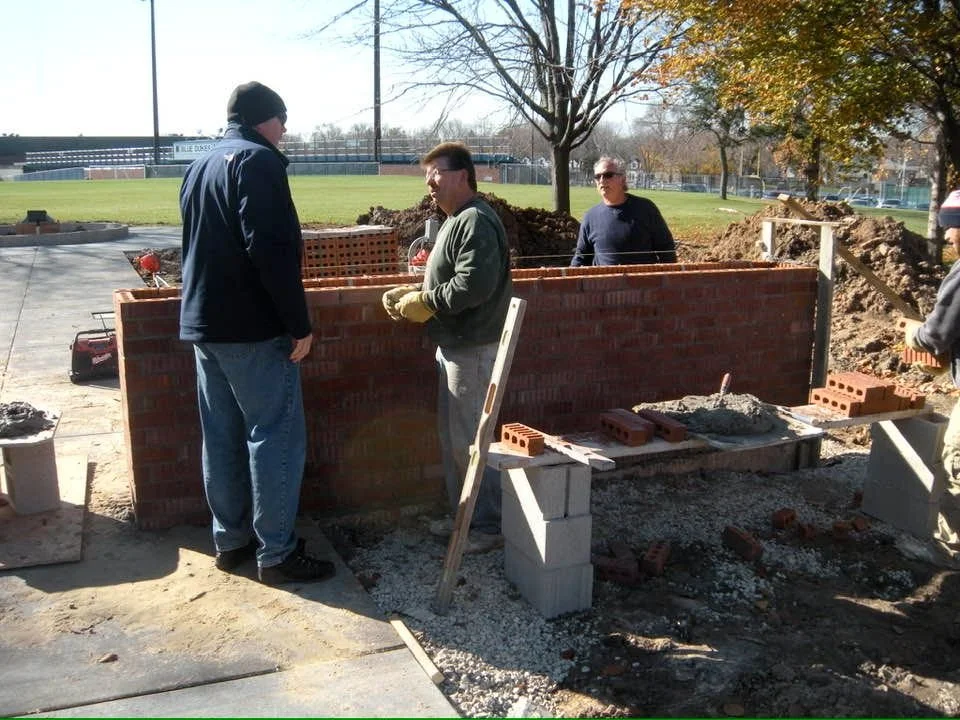
Volunteers constructing the Armory Park memorial
The centerpiece of Armory Park is the Whitefish Bay Veterans Monument and Memorial Garden, dedicated on Memorial Day 2010 after a six-year community effort. The idea originated in 2004 with David Kurtz, Milwaukee district commander of Wisconsin's American Legion and a Whitefish Bay resident. A task force called "Friends of Armory Park" was formed to oversee design and fundraising, led by former village trustee John Kearns, architect Jim French, and Ellen Abrams Blankenship, whose older brother served as a naval aviator and was killed in Vietnam.
The memorial's design draws directly from the 32nd Infantry Division's "Red Arrow" insignia. The layout traces the shape of an arrow: the feathers form a gathering area with an informational plaque, the shaft passes through donor walls and the memorial area, and the arrowhead contains the memorial garden where the American flag stands on a flagpole. Donor benches encircle the flag, providing a space for quiet reflection. Nearly 400 individuals contributed to the construction fund, and the village board unanimously approved the proposal in 2005.
As of early 2026, 56 plaques honor men and women who served in the U.S. military, many of whom made the ultimate sacrifice. The memorial welcomes additional plaques honoring veterans from all eras. In 2020, the Whitefish Bay Civic Foundation donated a $10,000 grant to further beautify the space, calling it "a wonderful location in our Village to recognize their service."
The Civic Foundation has organized an annual Memorial Day ceremony at the park since 2015, a roughly 45-minute event beginning at 11 a.m. that draws scouts, families, and veterans for what the village describes as "a solemn, reverent remembrance of those who have given their life to protect our country."
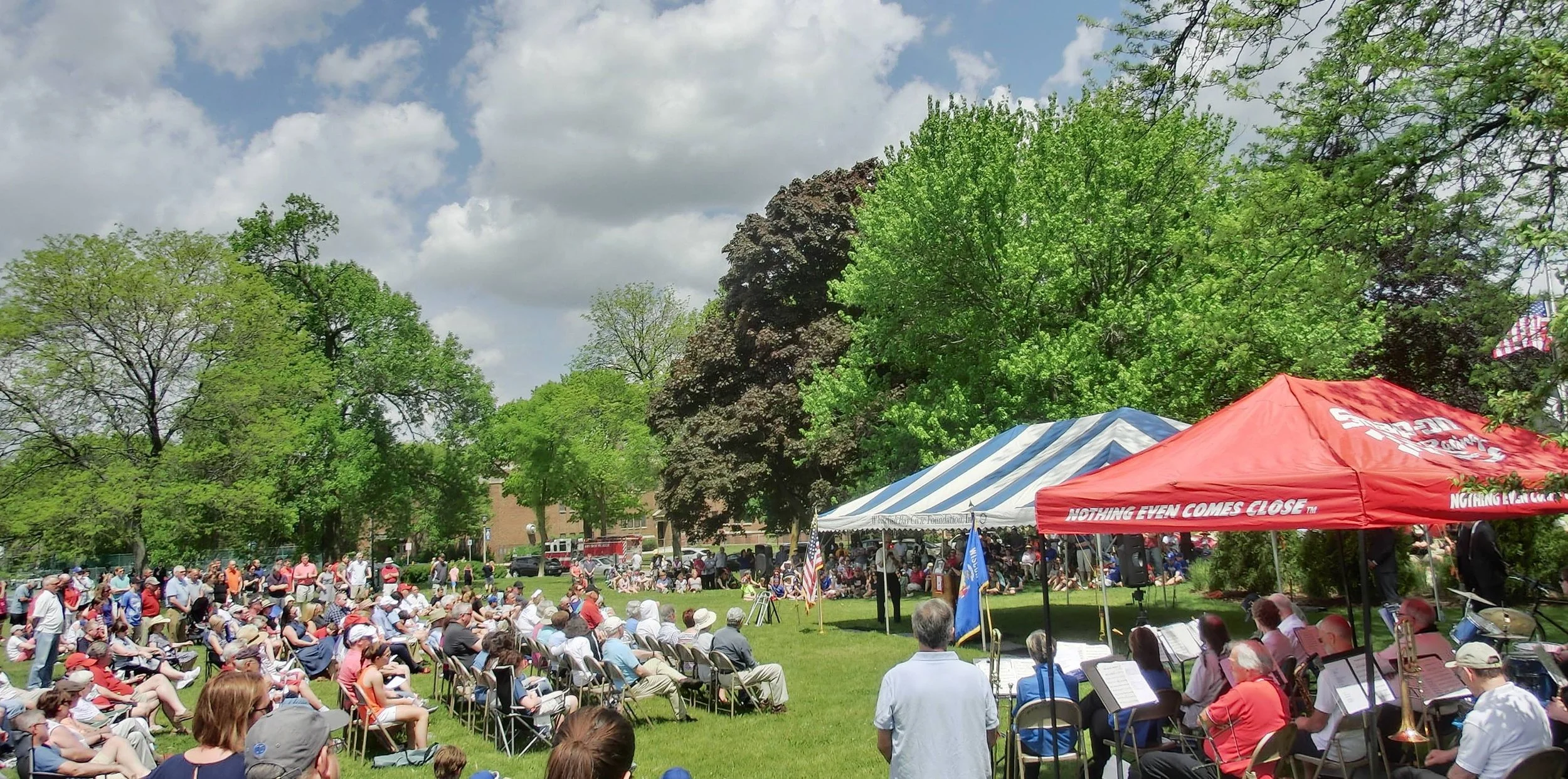
Mature trees and open green space
Armory Park is not a facility-heavy athletic complex — it is, by design, one large, continuous open field with mature trees, open sky, and long sightlines across the neighborhood. When the village chose in 1998 to raze the armory and create a park, it deliberately opted for shared open space rather than built-up recreation infrastructure.
The park's trees are large enough for children to climb and for residents to string hammocks in the shade on summer afternoons. While no formal tree species inventory of the park has been published, the trees are consistently cited by residents as a defining feature.
Resident Stephanie Schultz captured the sentiment: "I love walking by Armory Park and seeing kids and teens playing soccer there, friends playing frisbee and the beautiful trees. I chose WFB over our neighboring villages for its green space and easy walkability." Matthew Krueger echoed this: "Armory Park — with its memorial, trees, and green space — has provided an anchoring space to our neighborhood."
Given that the Rabe farmstead dates to 1870 and the land has never been commercially developed, some trees on the property could be quite mature, though no formal age assessments exist in public records. The Village of Whitefish Bay maintains an active forestry program and offers a Memorial Trees and Benches donation program for its parks, though specific plantings at Armory Park are not documented. It is the unstructured, natural quality of the tree canopy and open grass — not manicured landscaping — that gives Armory Park its distinctive neighborhood character.
T-ball, turkey bowls, and unstructured play

Armory Park's recreational value lies in its flexibility. Without formal ball diamonds, courts, or playground equipment, the open field accommodates a rotating cast of activities across all four seasons.
Spring brings the park's most visible organized program: the Whitefish Bay Recreation Department's T-ball league for children in K4 and K5. This co-ed, fundamentals-focused program uses the open grass field — not formal diamonds — and features parent coaches. Registration opens each spring through the Recreation Department (located at the Lydell School and Community Center, 5205 N. Lydell Avenue). The adjacent Whitefish Bay Middle School also uses the field for gym class and physical education activities.
Summer transforms the park into a neighborhood living room. Families spread blankets on the grass, children climb trees, hammocks appear in the shade, and pickup games of frisbee, catch, and soccer fill the field. Fall brings informal flag football, lacrosse and soccer practices, and the beloved tradition of turkey bowls — casual Thanksgiving-season football games. Winter sees snowball fights, snow fort construction, and snowman building across the open expanse.
The park's only formal built feature is the Veterans Monument and Memorial Garden, and its only major organized annual event is the Memorial Day ceremony. Donor benches at the memorial provide seating. The park is open sunrise to 9:00 p.m. per village ordinance. Whitefish Bay's other community events — the Fourth of July celebration, the Great Pumpkin Festival, the Ice Cream Social, and the Sounds of Summer concerts — take place at other village parks and along Silver Spring Drive.
A referendum would replace the park
The most pressing issue facing Armory Park is the Whitefish Bay School District's $135.6 million facilities referendum, scheduled for the April 7, 2026 Spring Election ballot. The single-question referendum would fund two major components: approximately $68 million for a new Whitefish Bay Middle School built directly on the Armory Park site, and approximately $88.3 million for infrastructure, safety, security, accessibility, and sustainability upgrades at all other district schools — Cumberland and Richards elementary schools, Whitefish Bay High School, and the Lydell School and Community Center. The district would also contribute $20.4 million from its operating budget and long-term capital improvement trust, bringing the total project cost to roughly $156 million.
The plan calls for constructing a new three-story middle school building on Armory Park, directly across the street from the current middle school at 1144 East Henry Clay Street. The current building — originally Henry Clay School, built in 1918 — would then be demolished and its footprint converted into "a separate square of green space with a mixture of parking and tennis courts." Supporters argue this approach allows the new school to be built while the current school remains operational, avoiding the need for temporary facilities. Whitefish Bay is a landlocked, fully built-out suburb with virtually no vacant land for large institutional construction.
The financial impact on homeowners would be significant. For a home valued at $600,000, that translates to roughly $1,560 more per year in school taxes. For the median home value in Whitefish Bay, the figure is approximately $1,463.80 per year for 21 years — the proposed borrowing term at roughly 5%–5.25% interest.
The quest to save Armory Park
The opposition frames the debate as a land-use and community-values question, not an anti-education stance. Their core argument: a "no" vote does not mean opposing better schools — it means rejecting this specific plan that would permanently eliminate one of the village's last large, uninterrupted green spaces and demolish a community-funded veterans memorial. They contend that the replacement green space — a smaller area mixed with parking and tennis courts on the demolished school's footprint — "is not the community park we have today. Those two things are not equivalent."
Community voices against the referendum have been passionate and specific. Resident Ian Gabik called Armory Park "one of the few pure green space parks left in the North Shore" and said "paving it over would be a crime and a shame." Betsie Berrien warned it would be "unwise to eliminate one of the few remaining large parcels" of green space. James Gomez was blunt about the memorial: "This is hallowed grounds. Don't ruin it." Gretchen Augustyn questioned the urgency: "Other cities are building underground buildings so they can keep their grass on top, and we might fill ours up with a new building at a huge cost for decades — without even seeing renderings. Let's pump the brakes."
The veterans memorial dimension has proven especially charged. The memorial was built with contributions from nearly 400 community members, unanimously approved by the village board, and holds 56 plaques honoring service members. As one opposition argument puts it: "To demolish this memorial just six years later sends the wrong message about our values as a village." Lawrence Abbott, whose son distributes flyers at the Memorial Day ceremony as a Scouting America troop member, spoke to the park's special significance for veterans and their families.
Resident Cate Olson suggested "creatively utilizing existing classroom space at Lydell." Critics note that no detailed architectural renderings of the proposed new school have been shared publicly, making it difficult for voters to evaluate what they would gain versus what they would lose.
News coverage has come primarily from TMJ4, which reported on the school board vote; the Milwaukee Journal Sentinel, which covered the referendum timeline; and the Powers Realty Group blog, which offered a real estate perspective noting that earlier planning had discussed figures as high as $328 million before the board settled on $135.6 million.
According to WTMJ4, some hesitations were raised, including concerns about whether the referendum addresses class sizes.
"Putting out a big referendum. It doesn't address class sizes or teacher pay, which I think is a lot more impactful," parent Jacob Narens said.
"The public will be surprised by this. This is a lot as everyone knows, and so we need to make sure that, as [the board] said, this is a need of the school. Everyone needs to believe this is a need," parent Yi Wei said.
The park's trajectory — from 1870s farmland to National Guard training ground to Wisconsin's finest armory to a deliberately created public memorial — represents a rare, continuous thread of civic identity stretching back over 150 years.
For a six-acre park in a village of 15,000, the stakes reach into questions of what a community chooses to build, what it chooses to keep, and how it honors the promises it made to those who served.


Donec id justo non metus auctor commodo ut quis enim. Mauris fringilla dolor vel condimentum imperdiet.