

Why Whitefish Bay May Remove Parking Meters — And What Could Replace Them
A trip to Silver Spring Drive for coffee, dinner or shopping could soon involve one less step: paying a parking meter.
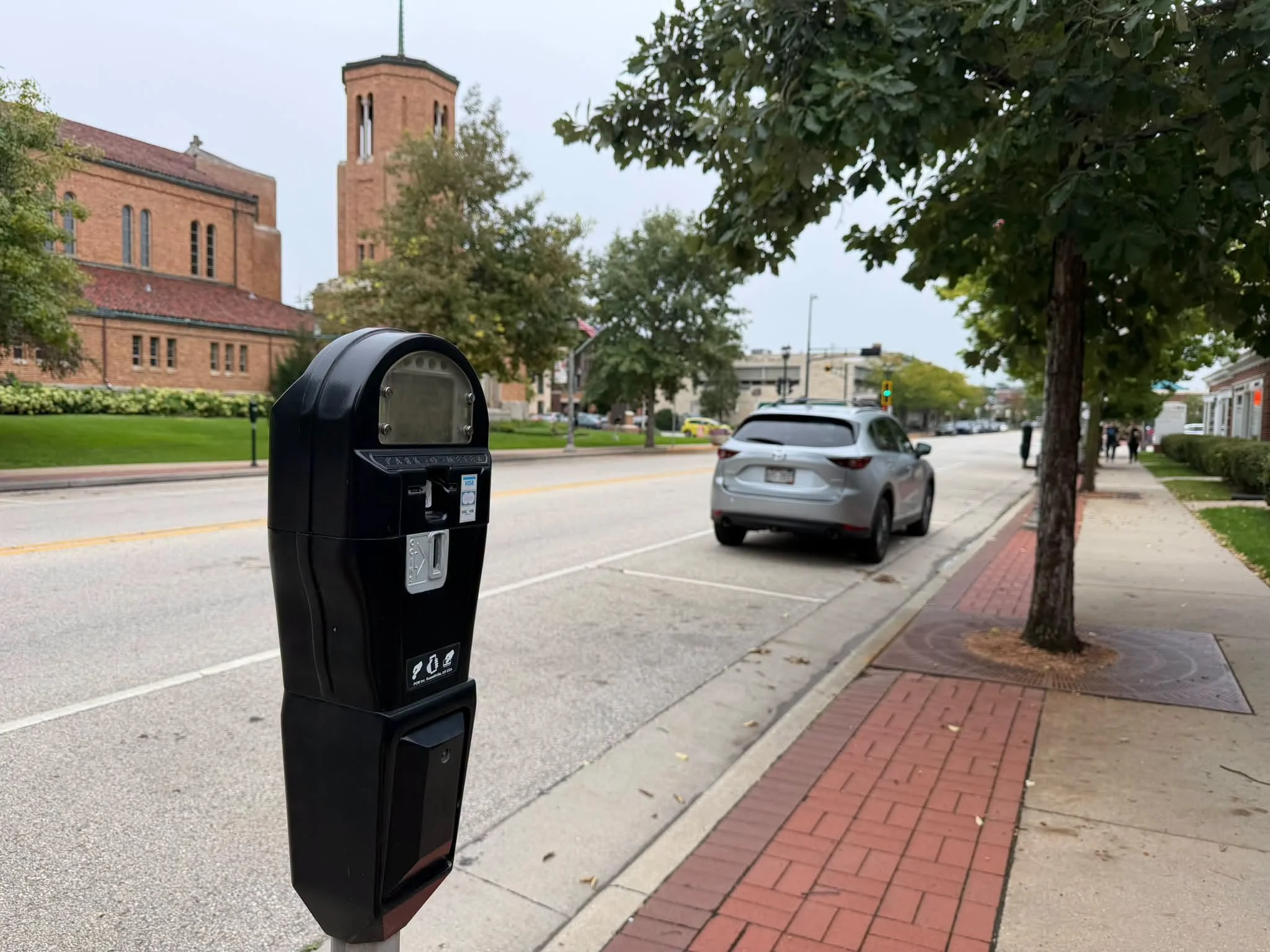
Whitefish Bay is considering a 60-day trial that would remove the meter heads in and around the Silver Spring Drive business district beginning October 1 while keeping the existing one-hour, two-hour and other posted parking limits in place.
But the proposal is about more than whether parking should be free.
The company behind Whitefish Bay’s meters is shutting down. Neighboring communities are increasingly using license-plate technology and virtual permits. Milwaukee has moved toward app-based payments and smart meters. And Whitefish Bay itself is considering whether some old meter poles could eventually become bike racks.
In other words, the Village’s immediate parking problem is part of a much larger shift in how communities manage limited curb space.
Why is Whitefish Bay’s parking-meter company shutting down?
Whitefish Bay currently uses meters and related technology supplied by POM Incorporated, a longtime Arkansas parking-meter manufacturer whose history stretches back decades.
According to POM’s August 18 letter to customers included in the Whitefish Bay Village Board packet, the company will cease operations October 1, 2026.
POM President Seth Ward III wrote that his family has owned the company since 1981. His father ran the company until his death in 2013, after which Ward operated it on behalf of his mother. Following his mother’s death in 2026, Ward and his sister began winding down her affairs, including POM.
Ward also said the family had tried for several years to sell the business but had been unable to find a buyer “in the age of mobile payments,” a trend he said accelerated after the pandemic.
That explanation fits a larger technological shift in parking.
Traditional standalone meters increasingly compete with mobile-payment apps, multi-space kiosks, license-plate-based systems and digital permits that require less hardware at every individual parking space.
POM itself traces its parking-meter history back to the former Rockwell parking-meter business, which POM purchased in 1976. The Ward family acquired POM in 1981. (Pom)
What happens to Whitefish Bay’s meters on October 1?
If nothing changes, the meters would not immediately become useless.
They could still accept coins and continue operating under their existing programmed rates.
But POM’s MeterManager and POMPay systems would stop functioning, wireless connections would disappear, and drivers would no longer be able to pay by card or mobile device. Replacement parts such as batteries would also no longer be available.
Whitefish Bay already has several meters out of service after Village staff was unable to obtain replacement batteries.
That makes simply maintaining the current system increasingly difficult.
Whitefish Bay’s proposed solution: try free parking
Village staff is recommending that Whitefish Bay remove the meter heads, cap the roughly 80 poles and conduct a 60-day pilot beginning October 1.
The existing parking restrictions would remain.
So if a space currently has a two-hour limit, it would still have a two-hour limit. Drivers simply would not have to pay during the trial.
Staff would collect parking data throughout the pilot and return to the Village Board in December.
The idea is to see what actually happens before committing to a permanent system.
Why not simply replace the meters?
Money is part of the equation.
Whitefish Bay currently collects about $55,000 annually from its parking meters while spending approximately $34,000 a year to operate the system.
That leaves roughly $21,000 in annual net operating revenue before considering the original capital investment.
The Village spent approximately $83,000 to install the current meters in 2019.
Removing the meters therefore means giving up revenue — but also eliminating most of the costs associated with maintaining them.
There is also a broader policy question: does Whitefish Bay need paid parking to create turnover, or can posted time limits accomplish the same thing?
The trial is intended to help answer that.
Businesses favor getting rid of the meters
The Whitefish Bay Business Improvement District has unanimously recommended removing the meters and replacing them with posted time limits.
According to the BID, business activity continues to increase, but evening events at The Argo have not caused a material parking problem on Silver Spring Drive.
Its bigger concern is long-term parking for employees.
The BID originally recommended two-hour customer parking, while later discussions included the possibility of moving toward one-hour parking on Silver Spring in 2027 to encourage even more turnover.
That distinction is important.
Removing parking meters does not necessarily mean making parking less regulated.
Whitefish Bay could ultimately make parking free while becoming more deliberate about how long people can occupy its most valuable downtown spaces.
Shorewood offers one nearby example
Just south of Whitefish Bay, Shorewood has already moved heavily toward license-plate-based parking management.
Shorewood does not require motorists with many types of parking permits to display a physical sticker or hangtag. Instead, the vehicle’s license plate is entered into the system, and police use license-plate recognition technology to verify parking permission. (Village of Shorewood)
Shorewood also uses different rules for different parking needs.
Some residential areas affected by commuter parking have two-hour daytime limits unless the vehicle has a residential parking permit. The Village currently charges $30 annually for those daytime permits. (Village of Shorewood)
Residents and visitors can also receive up to 20 free overnight on-street parking permissions per license plate each year before needing to purchase a longer-term permit. (Village of Shorewood)
The system is an example of how municipalities can manage parking without installing a payment device at every space.
Whitefish Bay already has an employee permit system.
There are currently 120 designated long-term employee parking spaces serving the Silver Spring business district — but 495 employee permits have been issued.
As part of the proposed trial, employees with permits could park for up to 10 hours on selected side streets while other motorists would remain subject to the normal one- or two-hour limits.
That would essentially create two different uses for the same curb space:
Short-term parking for customers.
Long-term parking for permitted employees.
If the idea works, it could allow Whitefish Bay to manage parking by who needs the space and for how long, rather than simply whether someone has inserted money into a meter.
Milwaukee has gone in another direction
The City of Milwaukee provides another possible model.
Rather than abandoning paid parking, Milwaukee has invested in smart meters and mobile payments.
City meters can accept coins and credit cards, while drivers can also pay through the MKE Park app. Milwaukee says its smart meters can communicate remotely with staff and provide real-time alerts. (City of Milwaukee)
The MKE Park system has also expanded beyond simply paying for a meter. Its current features include access to night and residential parking permits. (City of Milwaukee)
Milwaukee therefore represents the opposite end of the spectrum from what Whitefish Bay is considering:
Keep paid parking, but make the system increasingly digital.
Could Whitefish Bay join Milwaukee’s parking system?
Possibly.
The Village packet says Whitefish Bay staff has already spoken with the City of Milwaukee about a potential temporary solution that could allow an app payment option to continue alongside coins.
Village staff describes that as something that could preserve the existing parking system for a short period, although costs are currently unknown and officials believe another long-term solution would eventually be needed.
That leaves open several possibilities.
Whitefish Bay could eventually adopt a different mobile-payment platform.
It could install newer smart meters.
It could move toward centralized kiosks rather than individual meters.
Or it could decide after the pilot that it no longer needs paid parking at all.
Another possibility: turn the old meter poles into bike racks
One of the more creative ideas in the Village packet has nothing to do with cars.
The BID favors removing the meter poles entirely and converting some of them into bicycle parking.
There are 80 meter poles in the current system, including 43 on Silver Spring Drive.
Village staff estimates that converting about half of those Silver Spring poles into bike racks would cost approximately $6,600, including permanent signage.
That would turn infrastructure built to collect parking fees into infrastructure encouraging another way to reach the business district.
For a compact downtown like Silver Spring, that could be particularly useful during busy restaurants, community events and warmer months.
The bigger trend: parking spaces are becoming curb space
One of the larger shifts in parking policy is that municipalities increasingly think about the curb as flexible public space rather than simply a row of car-storage spots.
Depending on the location and time of day, the same curb can potentially serve customers, employees, deliveries, bike parking, accessible parking, ride pickups or special events.
Milwaukee already adjusts meter rules for construction and special events, including temporarily hooding meters while allowing the underlying parking regulations to change. (City of Milwaukee)
Shorewood has similarly created different daytime, residential, overnight and commuter parking systems rather than using one rule across the entire Village. (Village of Shorewood)
Whitefish Bay’s proposed employee-parking experiment follows that same general philosophy.
Instead of asking, “Should this parking space be free or metered?” the more useful question may become, “What should this space accomplish?”
Free parking also comes with an enforcement challenge
There is one tradeoff.
Meters make enforcement relatively easy.
According to Whitefish Bay staff, an enforcement officer can determine on a single pass whether a metered vehicle is in violation.
With conventional time-limit parking, an officer may need to make one pass to record the vehicle and another later to determine whether it exceeded the allowed time.
Whitefish Bay estimates maintaining the same enforcement level without meters could require roughly twice as much staff time.
Technology could solve that problem, but it is not free.
The Village points to Shorewood’s license-plate recognition software, which Whitefish Bay says costs Shorewood approximately $20,000 annually.
That means eliminating meters could eventually shift some parking costs away from payment hardware and toward digital enforcement.
What could Silver Spring parking look like?
The October pilot could lead Whitefish Bay in several different directions.
The Village could keep free, time-limited parking permanently.
It could adopt shorter limits on Silver Spring while creating more long-term employee spaces nearby.
It could introduce license-plate-based enforcement similar to Shorewood.
It could join or emulate Milwaukee’s mobile-payment system.
It could eventually replace individual meters with kiosks or another form of paid parking.
Or it could turn some former meter locations into bike parking and rethink how portions of the curb are used entirely.
For now, Village staff is specifically recommending the least permanent option: remove the meter heads, leave the poles in place and see what happens for 60 days.
What families should know beginning October 1
Nothing changes yet.
The Whitefish Bay Village Board is scheduled to consider the proposal Monday, September 21.
If the Board follows the staff recommendation, paid parking in the business district would temporarily disappear beginning October 1.
But the parking time limits would not.
So families heading to Silver Spring for coffee, dinner or shopping would no longer have to feed a meter during the trial, but they would still need to watch the signs and move their vehicle before the posted limit expires.
Planning a stop in the district? Browse our Whitefish Bay Patio Dining Guide, our guide to coffee shops across Milwaukee’s North Shore and our 2026 guide to kid-friendly restaurants across Greater Milwaukee.
Why this experiment is worth watching
On the surface, this is a story about an aging parking-meter system whose manufacturer is going out of business.
But it could end up being the catalyst for something larger.
POM’s closure is forcing Whitefish Bay to reconsider a parking system installed only seven years ago. The Village now has an opportunity to test whether it still needs paid parking, whether technology can replace physical meters, whether employees and customers need different parking rules and whether some curb space might be better used for bicycles or other purposes.
The decision after the 60-day experiment could therefore shape not just how much it costs to park on Silver Spring Drive, but how Whitefish Bay wants its business district to function in the years ahead.
The Whitefish Bay Village Board is scheduled to consider plans for new trees around the park and a significant rebuild of the Pee Wee baseball field.