

The Trees of Whitefish Bay: Why Our Canopy Matters
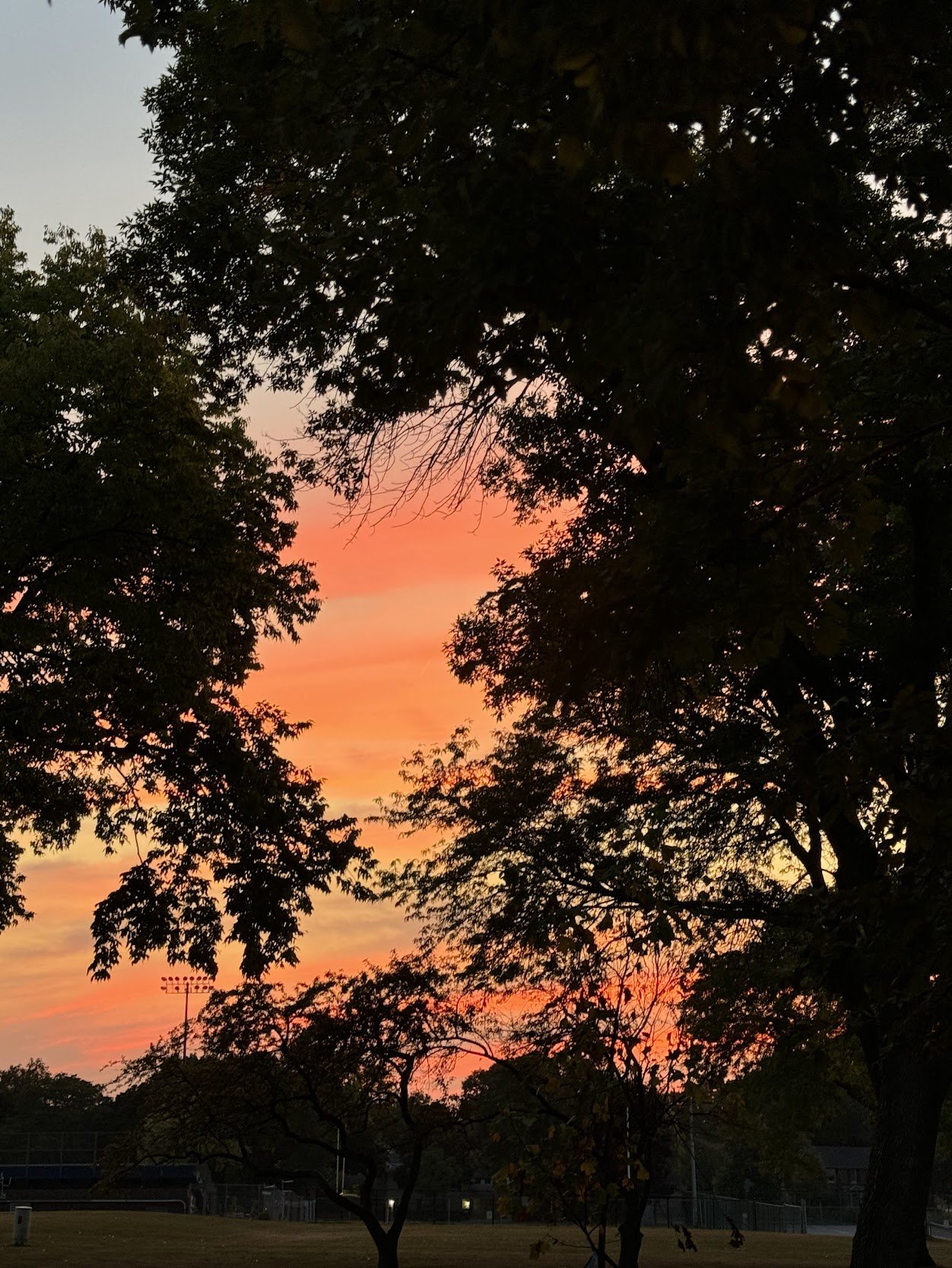
Trees over Armory Park in Whitefish Bay
If you’ve ever walked down a “tunnel street” in Whitefish Bay—where the branches meet overhead and the whole block feels a little cooler, quieter, and older than it should—you’ve experienced the village’s best piece of infrastructure that isn’t made of concrete.
Whitefish Bay maintains an inventory of 9,000+ public trees—the street and park trees that shape everything from neighborhood character to stormwater management—and it’s been recognized as a Tree City USA community for more than two decades.
But the most important thing to understand about our trees is this: they’re not just “nice.” They’re doing work every day—cooling homes, soaking up rainfall, filtering air, buffering wind off the lake, and making the village feel like the village.
How Whitefish Bay Became a Tree Town
Whitefish Bay’s canopy didn’t happen by accident. Early 1900s subdivision design (wide parkways, consistent setbacks, deep lots) basically invited big shade trees to grow up and define the streetscape. Over time, that created the signature look we all recognize: mature maples and oaks, long leafy corridors, and parks that feel like small forests rather than “just fields.”
Today, the village treats the urban forest like a living system that needs constant care—because it does.
The Village’s Tree Program in Plain English
Whitefish Bay prunes public trees on a 7-year cycle, meaning about 1/7 of public trees get trimmed each year, largely in winter when it’s safest for the tree and easiest for crews. The village also adds around 60 replacement trees each year, and residents are asked to help new trees survive dry stretches in mid/late summer.
And yes—those dots people notice on trunks actually mean something:
Black dot = the tree has been trimmed as part of the normal maintenance cycle.
Green dots (two, near the base) = an ash tree has been treated for Emerald Ash Borer.
Pink dot (when you see it) = an ash tree is slated for removal/replacement in the EAB program.
The Emerald Ash Borer Reality Check
If you’ve lived here long enough, you’ve watched ash trees go from “everywhere” to “uh oh.”
Whitefish Bay launched an Emerald Ash Borer (EAB) initiative in 2011, years before EAB was confirmed in the village. EAB was officially confirmed in late June 2017, with the first find reported near Lake Drive Court, north of Klode Park.
The village strategy has been two-track:
Remove and replace weaker/declining ash trees (and diversify the species mix).
Treat the strongest, best-positioned ash trees with trunk injections (emamectin benzoate) on a regular cycle.
The goal is to reduce ash from a dangerous near-monoculture (it was 47% of street trees in 2011) down toward a healthier long-term mix (around 20%).
This is the unglamorous side of loving trees: maintenance and hard choices.
Armory Park: A Park Built From History
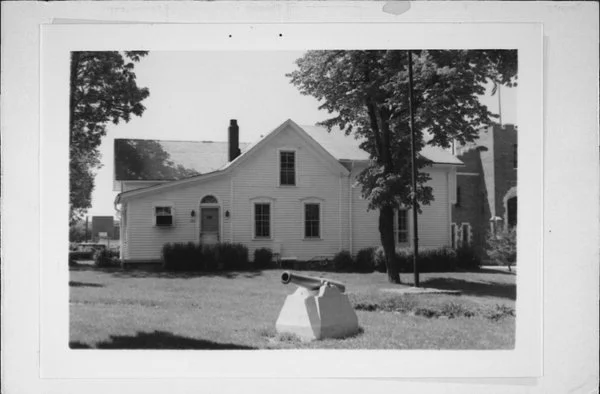
Before it was green space, the site of Armory Park held the Whitefish Bay National Guard Armory, built in 1928 and designed by architect Herbert W. Tullgren. It served military needs and doubled as a major community gathering place (think proms, weddings, civic events).
After the village purchased the property in 1995, public debate followed. The decision was made in 1998 to clear the buildings and create a park. The farmhouse was razed in 2000, and the armory/garages were demolished in 2004—making room for what we have today: open space, pathways, youth sports and T-ball leagues and the Veterans Monument and Memorial Garden, home of an annual Memorial Day Ceremony.
In other words: Armory Park exists because Whitefish Bay once chose green space over development.
Save Armory Park: The Trees Appeal
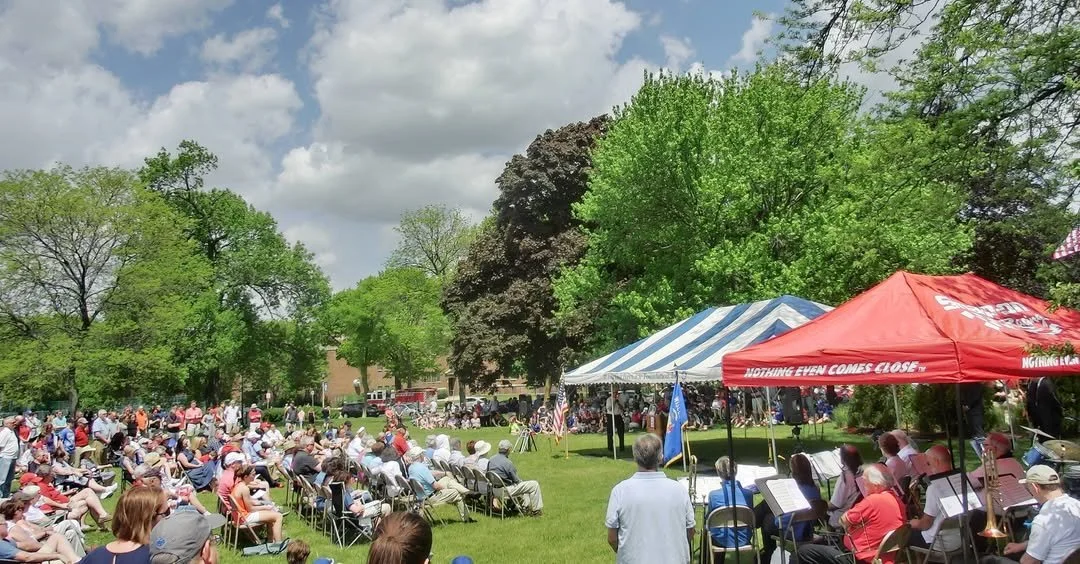
The Memorial Day Service at Armory Park
Fast forward to 2026, and Armory Park is back in the middle of a community-wide conversation. A proposed $135.6 million Whitefish Bay school referendum is set for the April 7, 2026 ballot, and reporting has noted that the plan includes building a new middle school.
At the same time, residents have launched the Save Armory Park campaign, arguing that building a school on the park would permanently erase one of the village’s last meaningful chunks of shared green space—and that once you remove mature trees and convert soil to building footprint, you don’t really get that ecosystem back on any human timeline.
You can disagree about buildings, budgets, or planning philosophy—but the tree question is straightforward:
A park is permeable ground plus canopy potential.
A building site is the opposite.
And Armory Park’s value isn’t only what’s there today—it’s what the park becomes as trees mature: more shade, more habitat, more cooling, more “room to breathe” in a village that doesn’t have much spare room left.
The Bottom Line
Whitefish Bay’s trees aren’t decoration. They’re a system we’ve built over generations—and we’re now actively managing through storms, disease pressure, and redevelopment pressure.
Armory Park is the clearest symbol of that tension: history turned into green space, and now green space potentially turning into something else.
If nothing else, keep your eyes up on your next walk. The canopy is telling the story—branch by branch.
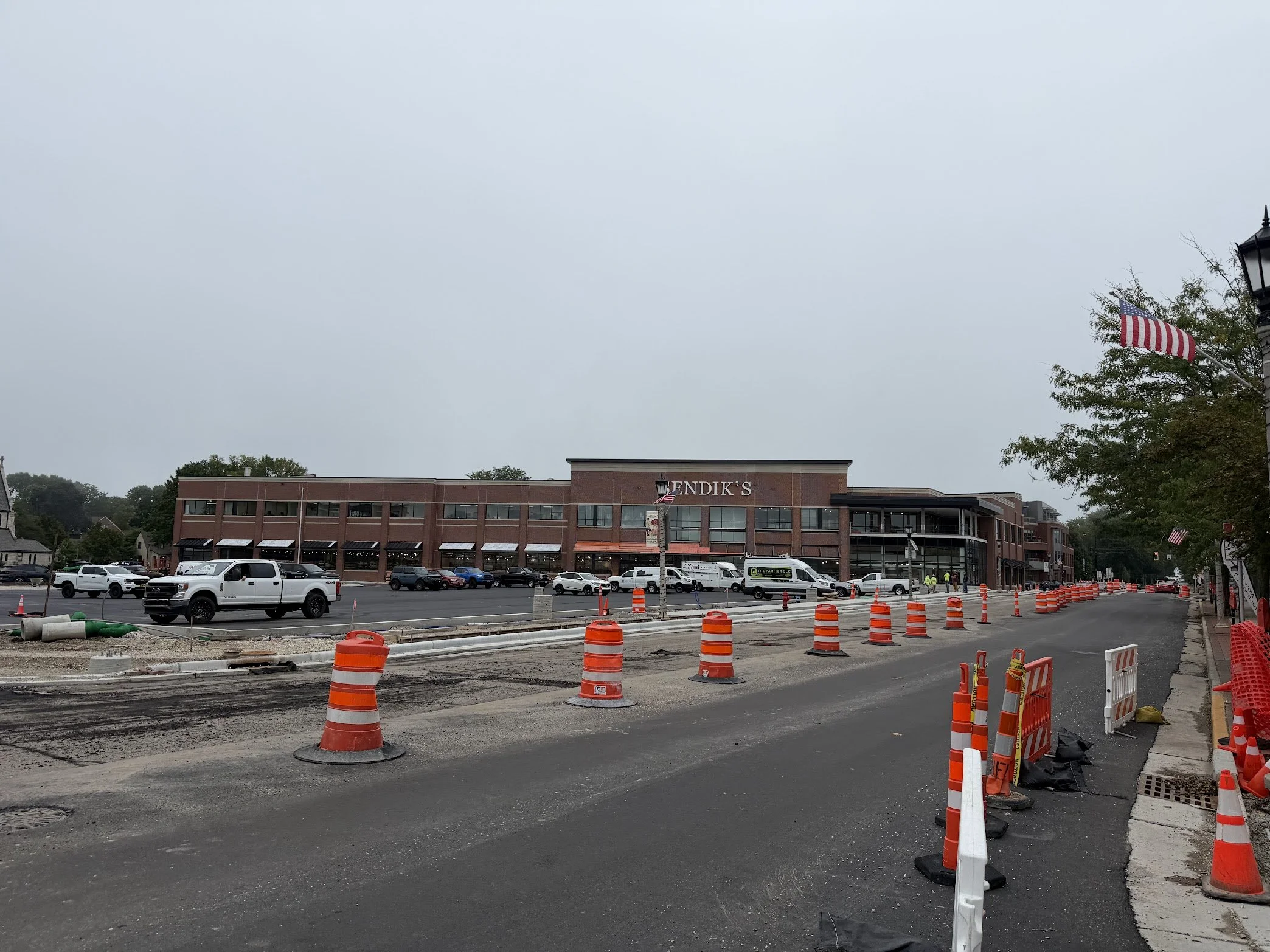
Four intersections near Whitefish Bay schools are moving closer to permanent safety improvements, with construction planned for summer 2027.