Milwaukee’s Beer Garden Tradition: Heritage and Revival
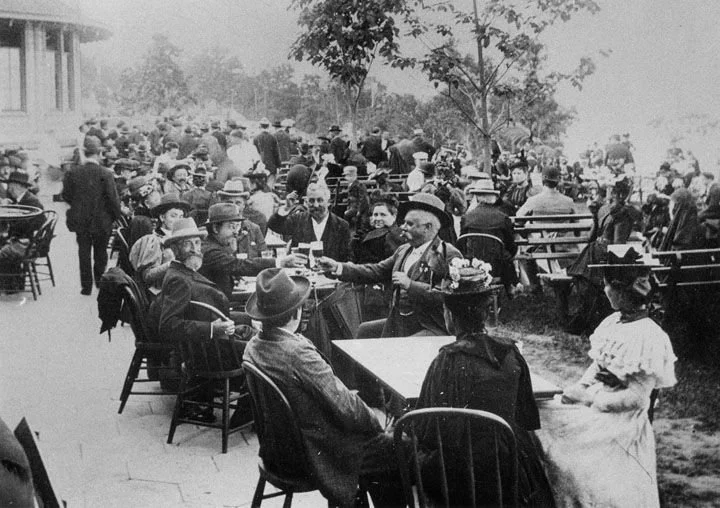
The Pabst Whitefish Bay resort. Photo via Pabst Mansion.
Picture a sunny Sunday afternoon in Milwaukee in the late 1800s: families gather under leafy chestnut trees, a brass band plays in the background, and parents and children alike enjoy pretzels, lemonade, and foamy steins of beer. This idyllic scene was common in the beer gardens of old – a German tradition transplanted to American soil.
In this article, we trace the history of beer gardens in America, beginning with their German roots and early Milwaukee heyday, through their decline during Prohibition, and finally to their 21st-century revival. We’ll especially explore how Milwaukee’s North Shore communities have reembraced beer gardens as welcoming, family-friendly community spaces.
German Traditions Bring Beer Gardens
The concept of the beer garden originated in Bavaria, Germany, where breweries set up outdoor gardens with communal tables so locals could enjoy beer in the shade of trees. German immigrants brought this beer culture to America in the 19th century, and few places embraced it as strongly as Milwaukee.
Writing in HistoryFacts.com, Nicole Villeneuve noted how the influx of German immigrants (along with Irish newcomers) taught Americans how to party:
Between 1815 and 1915, some 30 million Europeans arrived in the U.S. Over time, their unique customs became the life of the party, leading to what are now among the country’s most deeply established celebratory traditions. Irish immigrants staged one of the first recorded St. Patrick’s Day parades in the U.S. in 1737; by the mid-1800s, they celebrated at homes and in the streets in wild revelry every year.
German immigrants, meanwhile, many of whom settled in the cities of Milwaukee and St. Louis, not only changed every holiday party in the U.S. by introducing Christmas trees to the country, but also revolutionized the way America imbibes. As their lager beer quickly grew in popularity, so too did their beer gardens. These lively hubs drew working folks, young families, and courting couples. They gathered to socialize, enjoy live music, and relax outdoors in the open-air establishments — all while enjoying a brew, of course. While the specifics have evolved, these customs remain at the heart of every good party.
In an era before public parks were widespread, beer gardens served as informal community parks. Milwaukee’s early beer gardens—at least eleven were established between the 1840s and 1880s—offered a place to relax outdoors with family and neighbors, drink beer, listen to live music, play games, and share picnic foods. These venues were social hubs where all ages mingled.
As The Making of Milwaukee author and historian John Gurda noted, “you might go to church in the morning and spend the afternoon in the beer garden… There was no conflict whatsoever. It was a very family-oriented theme.”
In other words, beer gardens were about more than beer – they were about community, conviviality (what the Germans call Gemütlichkeit), and family fun in the fresh air.
Brew City’s 19th Century Beer Garden Boom
According to the Encyclopedia of Milwaukee, by the late 1800s, Milwaukee was the place for beer gardens in the U.S. In fact, by some accounts Milwaukee was “the undisputed leader in the number (and extravagance) of beer gardens” during that era. Local brewing titans built elaborate beer garden parks to promote their brands and provide entertainment. Pabst, Schlitz, Blatz, and Miller each developed grand beer garden resorts on the city’s outskirts.
These weren’t just picnic tables and trees – they were full-fledged pleasure grounds. Schlitz, for example, transformed a North Side park into Schlitz Park, complete with ornate pavilions, fountains, an observation tower, bowling alleys, and a large concert hall hosting live bands and opera performances.
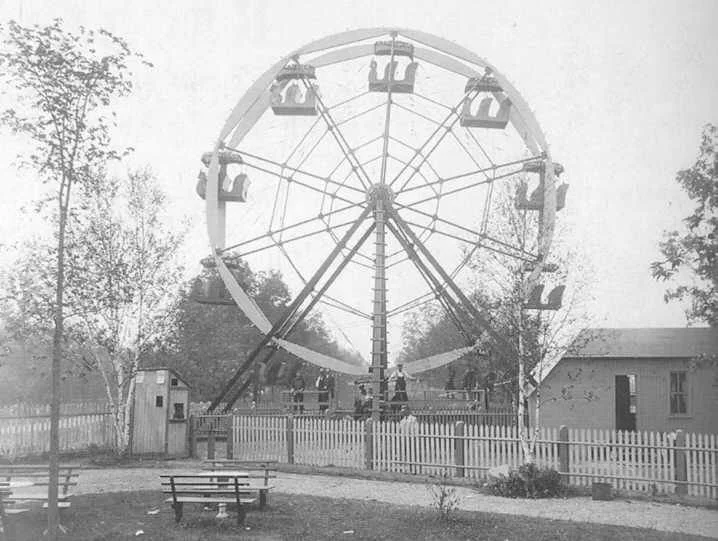
Captain Frederick Pabst opened a popular resort in Whitefish Bay (then a rural lakeside getaway) that featured attractions like a Ferris wheel and even served plank whitefish dinners to guests. Families would take an excursion to enjoy the lakeside breeze, music, and amusements at Pabst’s park. Not to be outdone, other beer gardens added novelty attractions inspired by the era’s new amusement parks – in 1885, one even installed Milwaukee’s first roller coaster, and by the 1890s Pabst’s park boasted a mini railroad, boat rides on an “underground” river, funhouse attractions, and more.
Despite the carnival flair, the atmosphere remained very much family-friendly. On weekends and holidays, beer gardens became popular picnic destinations for Milwaukee families of all backgrounds. It was common to see children laughing and playing games while parents socialized over a liter of lager.
Beer gardens also doubled as community gathering spots – local bands played in gazebos, civic groups held festivals and fundraisers, and neighbors caught up with each other on the grassy lawns. In many ways, these early beer gardens were the cultural heart of Milwaukee’s social life, blending refreshment with recreation. As beer historian Carl Miller explains, lager beer was “more than anything else, a social icon” representing friends, family, and camaraderie – and nowhere was that more true than at the local beer garden.
Prohibition and the End of an Era
The golden age of American beer gardens eventually waned. By the early 20th century, Milwaukee’s new municipal parks system and emerging amusement parks began to offer alternative leisure options, from proper playgrounds to roller coasters, reducing the novelty of brewer-run beer gardens. Then came the crushing blow: Prohibition.
In 1920, the United States banned the production and sale of alcohol, forcing beer gardens to close nationwide. Milwaukee’s once-grand beer gardens all vanished – Pabst Park, the city’s last major beer garden, shuttered in 1920 as the “dry” era began. Even after Prohibition was repealed in 1933, the old beer garden tradition did not immediately reappear. America’s social habits had shifted, and for decades the idea of drinking beer outside in a public park remained a quaint relic of the past. In Milwaukee, beer gardens survived only in memory (and in a few private or seasonal festival grounds). The lively family scenes of steins and songs in the park seemed consigned to history.
Milwaukee’s Beer Garden Revival
Nearly a century after Prohibition, Milwaukee is once again at the vanguard of beer garden culture. The revival began in 2012, when Milwaukee County Parks partnered with a local brewer to reopen a beer garden in Estabrook Park along the Milwaukee River. The Estabrook Beer Garden – often cited as America’s first truly public beer garden since Prohibition – tapped its first keg that summer.
To the delight of many, the community flocked to this new/old idea. What started as a small experiment (just a one-week trial run) turned into a runaway success. Park officials were astonished to see families, bicyclists, and neighbors lining up 100-deep for draft beer and pretzels under the trees, just like the old days. Word spread quickly, and soon national media and even cities around the world took note of Milwaukee’s beer garden comeback.
Over the next few years, the Milwaukee area opened several more public beer gardens. By the mid-2010s, nearly every corner of the county had access to one – from permanent beer gardens in parks to roving Traveling Beer Gardens that haul kegs on vintage fire trucks. The revival wasn’t just about beer; it was about community. The new beer gardens were deliberately designed as family-friendly spaces, staying true to tradition.
You can now find pop-up beer gardens all across greater Milwaukee, including several in the North Shore like the Klode Park Beer Garden and the Bayside Beer Garden.
Visitors bring their kids (and often the dog) to the park beer gardens for an afternoon of relaxation and fun. It’s common to see strollers and sandbox toys alongside picnic tables and beer steins. Milwaukee County’s beer gardens all serve root beer and other craft sodas for kids and non-drinkers, and many offer ice cream or snacks, making everyone feel welcome.
Live music is a staple on weekends – you might hear a polka band one evening and an acoustic guitar the next – adding to the festive, all-ages atmosphere. As in the 19th century, the focus is on community and camaraderie.
“The beer gardens in Milwaukee have historically been about more than drinking beer,” one parks director noted, emphasizing the sense of community these gatherings create.
In fact, Milwaukee’s modern beer gardens have been credited with drawing people back into the parks, increasing awareness and usage of public parks while also generating funds to support them. In short, the beer garden has returned to its roots as a social cornerstone – and nowhere is that more evident than in Milwaukee’s own North Shore suburbs.
Captain Frederick Pabst and the Whitefish Bay Resort
No chronicle of Milwaukee’s beer-garden golden age is complete without Captain Frederick Pabst—the onetime Great Lakes steamboat captain who turned his father-in-law’s Best Brewery into a national powerhouse and then built one of the Midwest’s most spectacular leisure parks on the Lake Michigan bluffs of Whitefish Bay.
In 1888, Pabst quietly bought roughly sixty acres of lake-front farmland just north of Milwaukee and invested about $30,000—a small fortune at the time—to create a resort that would showcase his beer and, just as important, give city dwellers a cool, breezy escape from summer heat. The Pabst Whitefish Bay Resort opened for its first full season in 1889 with a 48-foot circular bar, covered dining pavilions, a ladies’ parlor, and broad porches that looked out over the lake. Steam-powered excursion boats and later electric streetcars delivered throngs of visitors directly to the resort’s dock below the bluff.
Pabst modeled his complex on the grand German beer gardens of his youth and then upped the ante with amusement-park flair. A Ferris wheel that rose roughly 300 feet above the lake’s surface, daily band concerts (double concerts on Sundays), rowboat rentals, bowling alleys, boating regattas, and a roster of yodelers and brass bands kept patrons of every age entertained. Whitefish fresh-caught the same morning was served five ways, and—naturally—ice-cold Pabst lager flowed from gravity-fed wooden barrels. On peak summer weekends as many as 10,000 people—families with picnic baskets, courting couples, and curious out-of-towners—crowded the grounds, yet admission was free; Pabst counted on beer sales to cover his investment.
The resort thrived for a quarter-century and became a civic institution: Milwaukee newspapers breathlessly reported each spring on new attractions (one season added an “underground” canal boat ride, another a miniature railroad), and children grew up measuring summers by their trips to Whitefish Bay. But tastes changed as modern amusement parks and a growing county-park system offered newer diversions. Attendance slipped after 1912, and by 1914 Pabst closed the gates; in 1915 the land was subdivided into seventeen lakefront residential lots, erasing nearly every trace of the once-famed beer garden. Today only a small historical marker on Lake Drive hints that the quiet shorefront neighborhood was once Milwaukee’s most popular family playground.
Yet the spirit of Captain Pabst’s venture lives on. When Whitefish Bay hosts its seasonal Klode Park Beer Garden pop-ups, the sight of neighbors hoisting pints as children race across the lawn conjures a direct line back to the nineteenth-century resort a mile to the south. Milwaukee’s entire North Shore revival—Glendale’s Bavarian Bierhaus, Shorewood’s riverside Hubbard Park, Fox Point’s Longacre Pavilion events, Bayside’s Ellsworth Park series—owes a debt to Pabst’s gamble that beer, fresh air, and family fun belong together. More than a century later, that formula remains as refreshing as ever.
Beer Gardens in Milwaukee’s North Shore
Milwaukee’s beer garden tradition has deep roots, but it feels especially alive along the North Shore.
From wooded river spots and lakefront pop-ups to community park gatherings with food trucks, live music and root beer for the kids, the North Shore has turned the beer garden into something more than a place to grab a drink. It’s become a summer ritual.
Pack a blanket. Bring the stroller. Let the kids run around. Grab a pretzel, a pint or a Sprecher root beer. This is one of the easiest ways to enjoy a Milwaukee summer.
For the most current dates, hours and seasonal updates, start with our full guide to Beer Gardens Near Milwaukee’s North Shore. Below is a community-by-community look at the beer gardens that make this area such a fun place to explore.
Glendale: The North Shore’s Beer Garden Hub
Glendale may have the deepest beer garden lineup in the North Shore.
The most iconic stop is Bavarian Bierhaus at Old Heidelberg Park. This is the closest thing you’ll find to a traditional Munich-style beer hall and biergarten without leaving Wisconsin.
There are long communal tables, German beer, giant pretzels, live music and plenty of room for families to settle in. During big events like Oktoberfest, the whole place feels like a festival. Kids dance to polka music, parents clink steins, and everyone seems to understand the assignment: relax and enjoy the moment.
Glendale also has the Sprecher Brewing Outdoor Oasis at Richard E. Maslowski Community Park. This one is especially easy for families because it pairs craft beer with Sprecher soda and root beer. The nearby playground is a major bonus, giving kids a place to play while adults enjoy a casual evening outside.
For a more modern beer garden feel, The Yard at BAYSHORE has become a popular gathering space. Parents can grab food and drinks nearby while kids move around on the turf, play games or settle in for outdoor entertainment. BAYSHORE also hosts seasonal events like Sounds of Summer, making it a great pick for families who want a beer garden vibe with live music and easy parking.
For more Glendale options, check out our family-friendly guide to beer gardens near Glendale.
Shorewood: Hubbard Park’s River Retreat

Shorewood’s signature beer garden experience is Hubbard Park.
Tucked below street level along the Milwaukee River, Hubbard Park feels like a secret summer hideaway. The setting is peaceful and wooded, with picnic tables, river views and easy access from the Oak Leaf Trail.
The beer garden sits near Hubbard Park Lodge, one of Shorewood’s most beloved destinations. Families come for the relaxed atmosphere, the natural setting and the feeling that you’ve escaped the city without really leaving the neighborhood.
Kids can explore the grassy areas, watch ducks on the river or burn off energy nearby while adults enjoy a drink under the trees. It’s the kind of place where arriving by bike feels natural, especially since parking can be limited.
Hubbard Park also connects nicely with other seasonal events. The Summer Sounds at Hubbard Park series brings free music to the park, and the lodge itself is worth knowing year-round. You can read more in our full Hubbard Park Lodge guide.
Whitefish Bay: Lakefront Nights at Klode Park
Whitefish Bay brings the beer garden tradition to one of the prettiest spots on the North Shore: Klode Park.
The Klode Park Beer Garden is a seasonal pop-up with Lake Michigan as the backdrop. On beer garden nights, neighbors bring lawn chairs and blankets, kids head for the open space and playground, and the whole park takes on a relaxed community feel.
This is less of a permanent beer garden and more of a summer event series, which is part of the charm. It feels like a neighborhood block party with better views.
The lakefront setting makes Klode an especially good choice for families. You can arrive early for playground time, walk toward the lake, grab dinner from a food vendor and settle in for music or conversation as the evening cools down.
For families looking for an easy summer night, Klode is one of the North Shore’s best “don’t overthink it” options.
Fox Point: Community and Traveling Beer Garden
Fox Point has built its beer garden identity around community gatherings in local parks.
The Fox Point Beer Garden at Longacre Pavilion brings families together for craft beer, food trucks, live music and casual outdoor fun. The pavilion setting keeps things simple and welcoming: grab a drink, find a spot on the grass and let the kids play nearby.
Many families bring their own lawn chairs or picnic blankets because seating can fill quickly. The vibe is casual, neighborly and very Fox Point.
Fox Point also gets a major summer highlight when the Milwaukee County Traveling Beer Garden rolls into Doctors Park. That stop combines beer garden fun with one of the most scenic parks in the area. Families can explore wooded trails, visit the playground or hike down toward the lake before or after grabbing food and drinks.
For more details, check out our guide to Fox Point’s beer garden season and our story on the Traveling Beer Garden in Fox Point.
Bayside: Ellsworth Park Becomes a Summer Gathering Place
Bayside’s beer garden series has quickly become one of the area’s best community events.
The Bayside Beer Garden brings craft beer, food trucks, live music and family-friendly fun to Ellsworth Park and Village Hall on select summer dates. It’s not open every day, which makes each event feel like something worth marking on the calendar.
Ellsworth Park is a natural fit for this kind of gathering. There’s a playground, open green space, sports fields and room for kids to move. Families arrive with wagons, folding chairs, snacks and dogs, then settle in for an afternoon or evening outdoors.
The best part is that it feels less like a commercial event and more like a neighborhood festival. Kids run to the playground or start pickup games in the grass while adults catch up over a local beer.
You can also read more about the park itself in our Ellsworth Park guide.
More Beer Gardens Worth Exploring Nearby
The North Shore has plenty to keep families busy, but Milwaukee’s broader beer garden scene is worth exploring too.
Estabrook Beer Garden remains one of the classics, especially for families who want river views, playground time and a true Milwaukee beer garden atmosphere. Lake Park and Juneau Park are also easy add-ons for families looking for a lakefront outing.
For a bigger list, check out our guide to 65+ Milwaukee beer gardens. It’s a good resource when you want to branch out beyond the North Shore.
And if your family likes pairing beer gardens with live music, bookmark our Milwaukee North Shore free outdoor concerts guide. Many of the best summer nights combine the same three things: music, green space and something cold to drink.
Why North Shore Beer Gardens Work So Well
The best beer gardens are not just about beer.
They work because they give families permission to be casual. Kids don’t have to sit perfectly still. Parents don’t have to plan a complicated outing. Everyone can be outside together.
That’s why beer gardens fit the North Shore so well. They make use of the area’s best public spaces: river parks, lakefront lawns, playgrounds, pavilions and community gathering spots.
Some are traditional. Some are pop-ups. Some feel like neighborhood parties. But they all share the same basic promise: come as you are, stay as long as the kids allow, and enjoy summer while it’s here.
So grab a picnic table, raise a stein or a root beer, and say “Prost.”
Milwaukee’s beer garden tradition is alive and well on the North Shore.